This cracked me up. While searching Amazon for a wine fridge, I came across this page:
Anyone else find it amusing that wine drinkers also love Transformers? I can't help but imagine a bunch of snooty wine drinkers sprawled on the floor, sloshed to the gills, and arranging pretend showdowns between Optimus Prime and Megatron.
It's either that or there are a 14-year-old boys who really appreciate a properly chilled Gerwertraminer.
There are two types of people in this world: those who've lost data, and those who will. I've lost more data than I'd like to remember, and tonight, thanks to luck and some forewarning, I believe I've managed to avoid a catastrophic failure.
I've owned my black MacBook for just over a year, and it's been a great machine with several flaws. Everything that's gone wrong with the MacBook in general has gone wrong with mine: the case is loose on the left side; the case cracked on the front right; the battery lasted less than 90 minutes on a full charge; the screen flickers uncontrollably; and it has the Seagate hard drive that's been dying in large numbers.
I suppose that's the price for being an early adopter: I bought the 'Book September of '06, shortly after it was released, after my beloved 12" PowerBook seemingly died. (I managed to recover that machine, but not before I'd place my MacBook order.)
When I first read about the Seagate hard drive issues, I started cloning my system. Carbon Copy Cloner (CCC) is a great tool, and has made it easy to keep a backup system going. Then tonight, I decided it was time to upgrade the MacBook to Leopard; it was my last machine (of four that I use; two personal, two work).
Because CCC has worked so well for me, I decided to abandon my normal policy of at least two partitions on my machines ( one System, one User, so I can blow away the OS when things went wrong) and went with a single partition. I cloned things to my (now spare) PowerBook, and wiped out my User and third partition using the Leopard Disk Utilities, expanded the remaining partition to fill the drive, and did an archive install.
Things seemed to mostly work, and I copied my data back to the MacBook, and rebooted to see all my files. Only upon trying to do some additional work on the machine did I encounter trouble, ending in a full out system hang. On reboot, the internal drive wasn't there. It simply didn't show up, like it was disconnected. Nothing I could think of would make it show up.
Sigh.
Were it not for the clone, I would have lost dozens of gigabytes of extremely valuable data, including the 1200 or so photos I took on my just-ended ten-day road trip. Had I not backed up tonight, I'd be drowning my sorrows in a bottle of single malt.
I now plan on doing a clone of my clone (paranoid? Hardly!) and get the spare PowerBook booting so I can at least have a portable machine while I take the MacBook into an Apple Store. I'm hoping though that they'll simply replace the drive on the spot: it's a couple of screws in the battery compartment. I'd do it myself but I don't think I should pay the $100 or so for a new drive.
Let this be a warning to you: if you have data you care about, please back it up, then test that backup.
Interested in some backup solutions? Carbon Copy Cloner is great for creating bootable backups and works in Mac OS X 10.4 (Tiger) and 10.5 (Leopard). Synchronize! X Pro and ChronoSync are both useful for keeping two drives in sync, and provide more options (though not necessarily needed ones) than CCC. Time Machine (part of Mac OS X 10.5) is great for creating regular snapshots of your drive throughout the day.
In 1948, Strom Thurmond formed the States' Rights Democratic Party (aka the "Dixiecrats") with the express goal of having "Segregation Forever," with the help of 35 Democratic National Convention delegates from Alabama and Mississippi.
In 1964, three men who were helping register blacks to vote were murdered in Philadelphia, Mississippi.
In 1980, Ronald Reagan kicked off his bid to be president at a county fairground near Philadelphia, Mississippi, declaring "I believe in states' rights".
"States' rights" has historically been a "code word" signifying support for racial segregation. It's part of the Republicans' "Southern Strategy," where they apparently court white, supposedly racist, Southern voters as a way toward success gaining the presidency and Congress.
I provide this bit of history because there's some fascinating back-and-forth going on in the New York Times' opinion columns recently. New York Times columnists Paul Krugman and Bob Herbert have been publishing essays on the "anti-black" G.O.P and the "states' rights" phrase in their opinion pieces and in Krugman's new book, "The Conscience of a Liberal". Apparently the repeated use of the phrase to disgrace Reagan, and, by extension, the whole Conservative Republican party as racist, concerned fellow NY Times columnist David Brooks, who wrote his own column defending Reagan.
But NY Times columnists seemingly aren't permitted to argue with each other by direct reference in print (or in their blogs); what we end up with is an intriguing, but difficult-to-follow asynchronous debate among respected journalists who can't mention each other by name.
Thus Ronald Reagan, who began his political career by campaigning against California's Fair Housing Act, started his 1980 campaign with a speech supporting states' rights delivered just outside Philadelphia, Miss., where three civil rights workers were murdered. In 2000, Mr. Bush made a pilgrimage to Bob Jones University, famed at the time for its ban on interracial dating.
Herbert adds some color (no pun intended) to this argument in his piece a day later, "The Ugly Side of the G.O.P." by stating:
"I believe in states' rights," said Mr. Reagan. The crowd roared.
Other mentions over the subsequent weeks (and the many apparent references in Krugman's book) eventually led Brooks to respond, in that "I can't tell you who I'm referring to" manner, kicking off his "History and Calumny" piece on November 9 with:
The distortion concerns a speech Ronald Reagan gave during the 1980 campaign in Philadelphia, Miss., which is where three civil rights workers had been murdered 16 years earlier. An increasing number of left-wing commentators assert that Reagan kicked off his 1980 presidential campaign with a states' rights speech in Philadelphia to send a signal to white racists that he was on their side. The speech is taken as proof that the Republican majority was built on racism.
Indeed, you do really have to feel sorry for Reagan. He just kept making those innocent mistakes.
And two days after that, Herbert also "responds," providing some historical context of the 1968 murders and the 1980 Reagan appearance in "Righting Reagan's Wrongs?":
That was the atmosphere and that was the place that Reagan chose as the first stop in his general election campaign. The campaign debuted at the Neshoba County Fair in front of a white and, at times, raucous crowd of perhaps 10,000, chanting: "We want Reagan! We want Reagan!"
Reagan was the first presidential candidate ever to appear at the fair, and he knew exactly what he was doing when he told that crowd, "I believe in states' rights."
Reagan apologists have every right to be ashamed of that appearance by their hero, but they have no right to change the meaning of it, which was unmistakable. Commentators have been trying of late to put this appearance by Reagan into a racially benign context.
That won't wash.
I can't wait to see how these columnists respond to each other (without responding to each other) in the upcoming weeks.
Interestingly, a non-NY Times author has jumped into the fray: American history professor Joseph Crespino, on History News Network, does a solid job summing up both sides of the argument, while coming down clearly on the side that Reagan knew what he was doing with his appearance and "states' rights" line:
[...]
Reagan knew that southern Republicans were making racial appeals to win over conservative southern Democrats, and he was a willing participant.
Crespino also touches on other instances of Reagan's methods of appealing to specific voters and voter fears:
Throughout his career, Reagan benefited from subtly divisive appeals to whites who resented efforts in the 1960s and 70s to reverse historic patterns of racial discrimination. He did it in 1966 when he campaigned for the California governorship by denouncing open housing and civil rights laws. He did it in 1976 when he tried to beat out Gerald Ford for the Republican nomination by attacking welfare in subtly racist terms. And he did it in Neshoba County in 1980.
And, if you have the time, look for a copy of They Should Have Served That Cup of Coffee, a collection of retrospective essays from 1960s activists. You can read most of it for free on Google at the previous link, or you can pick it up at Amazon or your local used bookstore. And don't forget Paul Krugman's book, The Conscience of a Liberal.
Everyone knows by now that Gmail has opened IMAP up to everyone. Well, OK, perhaps not everyone. Someone people, like Ying, don't have Gmail IMAP on their accounts. Ying is particularly upset, because I have it, she doesn't, and she's the one who invited me to Gmail in the first place, three years ago.
I almost never use Gmail. I have my own domain name (several, sadly). I run my own mail servers for some of those domains. I use barely 1% of my available account. And yet, I got IMAP the first night it was available.
I immediately set up my iPhone and OS X Mail, and they took forever to sync. After playing with it for a few minutes to make sure it worked, I promptly turned it off. What can I say? I have no need for Gmail.
Besides, I share way too much information about myself with Google. They know my searches, my websites, my destinations, my social security number (thanks to AdWords and AdSense)... I just don't feel right giving them even more information about me.
I hope Ying gets her IMAP soon though. She's been obsessively checking GMail three or four times a day. I fear she may lose her mind if IMAP doesn't get enabled quickly.
Fifteen years ago I sat through a multi-level-marketing sales pitch. I don't remember what company or what product; I recall only two things: One, thinking "this is interesting, but what if I don't sell any products or don't find anyone for my downline?" (yes, even in my 20s I was jaded and cynical); and two, the sales guy, at the front of a room of 150 eager listeners, pitching the ultimate in freedom: walking to work every day with a single manila folder, with a single sheet of paper representing your sales.
I've returned to that latter image many times since then; it's proven to be quite enduring.
Khoi Vinh, over at Subtraction.com, envied the "free spirits" who carried nothing with them as they strolled into work, unencumbered by large bags, and tried to emulate them. For a couple of days, he ditched his baggage, which consisted of
a bag or briefcase in which I carry a stack of papers, my checkbook, a wallet, a small attaché for credit cards, my New York Times identity card, a point-and-click digital camera, extra pens, my iPod and my iPhone, the latest issue of The New Yorker and my keys.
He didn't stick with it, though, because his concern of not having a place for his stuff make him antsy. I think my girlfriend might understand where he's coming from: hearing the list of items she carries every day might take the better part of your lunch hour.
I have a slightly different mentality. A year or so ago, spurred on by that fifteen year old memory and maybe a spark from 43Folders I went on a bit of a minimalist kick. Among other things, I ditched my bulking tri-fold wallet for a front pocket billfold. I eliminated as many credit, loyalty and ID cards as I could from my wallet and picked up a Lodis money clip. In that wallet I carry only:
my driver's license
American Express (for 90% of purchases)
MasterCard (for the other 10%)
Bank ATM card (two; should reduce it to one)
AAA card (in my wallet in case I lock myself out of the car)
Healthcare ID and payment card
A few bucks in cash
I have other cards, of course, like my Costco or Albertson's cards: I keep them in my car. Since I never find myself in these stores without my car (or with someone who also has one of these cards), I don't need to have it on my person at all times.
Beyond the wallet, I try to reduce the amount of stuff I carry on my person. My front door has an electronic lock rather than a traditional one, eliminating one key, and I keep my mailbox key in my car, eliminating a second one. The only keys I carry every day are for my car, my office and my girlfriend's apartment (and I'll probably move the latter to a separate keychain and keep those in the car too).
Alas, I haven't quite eliminated everything from my person. On an average "leaving the house" day, I stuff my pockets with a fair number of items: my wallet, the keys, a Moleskine notebook, a Tul pen, my iPhone and my first-gen iPod nano (mostly for the car). I'm looking at ways of eliminating some of this, but the Moleskine and pen are very important for Getting Things Done.
(If Apple ever introduced a good way to capture random thoughts on my iPhone and sync it back to my computer, I might ditch the notebook. Maybe.)
Like Khoi, when going to work I still find myself tied to a shoulder bag to carry stuff, in my case, my MacBook, an external hard drive, a first-gen iPod shuffle-as-thumb drive (never used), a real thumb drive (used regularly), my company VPN token, a pen or two and usually a magazine or something I've printed from work to bring home. If I really tried, I could probably get away with just the Macbook and thumb drive most days.
I haven't yet extended my minimalist ways to the rest of my life, unfortunately. I am still, by my nature, a pack rat, as one glance at my garage or home office will attest. I recently picked up an audiobook copy of It's All Too Much: An Easy Plan for Living a Richer Life With Less Stuff. (In an irony perhaps only I will appreciate, it is, of course, unabridged.) I haven't yet listened to it; perhaps it will provide some motivation for minimalizing beyond my wallet.
Two days ago I ordered a three-pack of Field Notes Notebooks. (Think of them as the start of a backlash against the seeming ubiquity of Moleskine users everywhere.) I first heard about them from a side reference on Daring Fireball earlier this year. Today I got SPAM from Coudal Partners, the makers of Field Notes, asking me to opt-out if I don't want any more mail.
You're receiving this because you signed up at Coudal.com or Jewelboxing and/or you recently bought something from us or one of our brands, like a Pixies or Dead Can Dance CD or a tee-shirt or Field Notes or something else (we're a small creative firm in Chicago and we do a lot of different things). Whatever the case, thanks for signing up. If you'd like to quit getting these occasional missives, just click "unsubscribe" at the bottom. We're really very good about that.
I call it SPAM because, despite their comments in the email to the contrary, I didn't sign up for this email. Instead, Coudal decided (I assume), that since I ordered from them, clearly I must want to get email from them too. What does the Spamhaus Project say about this?
Opt-Out:
Unconfirmed Opt-In: If an Opt-in request is unconfirmed, then it can not be verifiied. If it can not be verified then the Bulk Email Sender can simply say "You opted-in" which is why almost all spam claims "You opted-in to this list".
I revisited the Field Notes website looking for where in my order process I got the chance to opt in or opt out, or a blurb that informed me that I'd be added to their mailing list, and found nothing. Not a single checkbox; not even a field for my email in the first place.
Where, exactly, did I sign up for this email?
(Ironically, this is the only email I've received from Coudal Partners. No order confirmation, nothing. Only a payment confirmation from PayPal; that's where they got my email address, by the way.)
This is the height of conceit in many companies, the assumption that I want to receive their marketing screeds, which often have nothing to do with why they may have my email address. In this case, Coudal thought I'd want to know about something called "Layer Tennis", which, near I can tell, is a bunch of Photoshop jockeys competing in an on-line design contest.
What, exactly, does manipulating images have to do with buying a set of notebooks?
After only a single interaction with Coudal, I'm already doubting my decision. Is this kind of behavior what I should expect? Should I worry that my email address will be sold? (Fortunately I use company-specific email addresses, so I can just change the one I use for PayPal if I need to.)
C'mon Coudal. I trusted you to do the right thing because Gruber usually does, and he uses you for his advertising, along with A List Apart, 37 Signals, and The Morning News, all sites I respect. If you want to email people, create a real confirmed opt-in list. Don't just assume your customers want your marketing mails, no matter how "infrequent" that mailing is.
I recently added Ask MetaFilter to my news reader. It's a colossal waste of time, but occasionally will have something that educates or amuses.
The latest example is a mom who sticks bad jokes into her five year old's lunch box every day, and wanted a resource for those jokes. Not only did the "hive mind" come up with some classic gems, e.g.
they also came up with URLs full of these groaners. I spent several minutes laughing stupidly. From Squigly's Jokes & Riddles came these:
and
and
and
and
Alas, my girlfriend didn't find these amusing. I don't understand why. Here's a final one, from Bad Puns, that may explain it:
Two parts of the eye were discussing who told better puns. Their debate raged on, till one said to the other, "You, my friend, are simply the pupil. I am by far the cornea of the two of us."
Anyone who tells you owning a house is a pure joy has never owned a house. Yes, yes, the American Dream, pride of ownership, blah blah blah. Bottom line? When you become a home owner, you take on all the problems your landlord used to handle, and then some.
Case in point: my dishwasher is being recalled. The manufacturer (Maytag) says liquid rinse-aid (e.g. Jet Dry, which I use and just refilled two days ago) can leak into the dishwasher's internal wiring, short circuit, and catch fire.
Maytag Corporation has received 135 reports of dishwasher fires, resulting in product and/or property damage.
Anyone find it ironic that a device that fills with water during its use might catch fire? Yeah, me too.
My model, a Maytag that came with the house and is somewhere between six and ten years old, is within the serial number range, so I called and, after several minutes of Automated Phone Tree Hell, they confirmed I'm covered, and offered either to pay for an in-house repair, or give me $75 toward the purchase of another Maytag, Jenn-Air, Whirlpool or KitchenAid dishwasher.
I took the cash.
While I look for a new dishwasher, I'm not supposed to use this one. Three separate times on their website, Maytag says those with affected units should
Stop using the product(s).
Disconnect the electric supply to the product(s) by shutting off the fuse or circuit breaker controlling it.
Inform all users of the product(s) not to use due to the risk of fire.
Stop using the product and wash my dishes by hand? Are you crazy? I'll just keep a fire extinguisher handy.
Four injuries have been reported, including three reports of smoke inhalation and one serious hand laceration when operating a fire extinguisher to put out a fire in the dishwasher.
Well, I've been using it for two years without trouble. What are the odds of it igniting after I read about the recall but not before? Hm?
Yes. Customers that have an affected unit should (etc.)
By the way, this is one reason why you should register your purchases. If the previous home owner hadn't done so, I may never have heard about this. If you have a Maytag or Jenn-Air dishwasher, take a look at the Maytag recall website to see if your dishwasher is affected.
Well, I've been wanting to buy a new dishwasher anyway. Now it'll be $75 cheaper. Now, if I can just find a good sale....
, Richard Pryor figured out that he can make himself rich by taking the fractions of pennies left over from rounding down on financial transactions. Corporations for years have added millions of dollars to their bottom-line by raising rates a few pennies per customer (calculate PG&E's 9.1 million customers getting a one-cent-per-month increase: $1,092,000 a year). And financial institutions use money in your account as loans and investments.
This is the likely explanation for why ETrade doesn't let me move pennies out of my brokerage account. I have with ETrade a brokerage account, a checking account and a home equity line of credit (HELOC). I recently noticed a $4.16 payment due on the HELOC, and $3.04 in the brokerage. I figured I'd use the brokerage to pay off the HELOC, with the difference coming from checking.
Nope.
Oh, it'll tell you it will work, but will fail at some later point. The error message was classic too:
Transfer failed-insufficient funds
I have exactly $3.04 in there, I'm transferring $3.04, and yet it fails. When I call up their automated system, I'm told I have $3 even in the account! That four cents? Nonexistent as far as their system is concerned.
There appears to be no way to get fraction of dollars out unless I close the account. I could add $0.96 and then pull out the whole dollar, of course. But what a crazy workaround to a non-problem.
Update: Now that Apple's updated GarageBand, you can make your own iPhone ringtones without any of the hackery below! Don't have GarageBand? It's part of iLife '08. It also comes for free with any new Mac, like the all-in-one 20" iMac.
First of all, I didn't figure this out. I'm simply putting a few pieces together from other people. That said, here's how I was able to get ringtones on my iPhone from my MacBook, completely free.
Clue Number 1: You can mount your iPhone as a hard drive. I don't remember where I first learned about this, but MacFuse and iPhoneDisk makes this trivial. This allowed me to mount my iPhone and copy files directly to it.
Clue Number 2: Ringtones are stored in a user-accessible location. One place I learned about this is Erica Sadun's article on the O'Reilly Network. Erica's article says to put the music files in /var/root/Library/Ringtones (which, when you mount your iPhone via iPhoneDisk translates to /Volumes/Library/Ringtones); this location didn't work for me, though.
Clue Number 3: Ringtones need a special file to point to them. I got this from a post on pastebin.com, where the author Keldegar points out that you need a specially-formatted file called a "plist" (short for "property list", which store preferences and so on). The author also pointed to a different location from what Erica at O'Reilly pointed to; this new location (/Volumes/Media/iTunes_Control/Ringtones) worked for me.
Putting these three clues together, I'm now able to use any audio files iPhone can play as a ringtone! Here's the step-by-step; it's more complicated to write it out than to actually do it.
Download and install iPhoneDisk. The latest version as of this writing is iPhoneDisk-20070826.
Double-click iPhoneDisk; it shows an icon
in the menubar to show it's running.
Connect your iPhone. A hard-drive icon named "Media"
should show up in Finder. iTunes will launch and sync if it's set to automatically do that.
In Finder, open the Media drive and then the iTunes_Control folder.
Create a new folder inside iTunes_Control named Ringtones.
Copy the music you want to use as a ringtone into the Ringtones folder.
Now comes the slightly tricky part. You'll need a text editor (not a word processor!). I'll assume you'll use TextEdit, but you can use BBEdit/TextWranger, TextMate, Coda, etc.
In TextEdit, make a new file (File > New) and convert it to plain text (Format > Make Plain Text).
Copy and paste the following code. You will need to change it in a couple of places to match your songs (see the next step).
Hopefully it's clear what to copy and where to paste it. Download this Ringtones.plist file as a starting point. (As an aside, if you're a Mac developer with the Xcode tools installed, you can use /Developer/Applications/Utilties/Property List Editor to make short work of editing this file.)
Save this file as Ringtones.plist to /Volumes/Media/iTunes_Control/iTunes/Ringtones.plist.
Now navigate on your iPhone to Home > Settings > Sounds > Ringtones and you should see your list of ringtones!
Troubleshooting
Things don't always go perfectly. Here are a few items that might cause some issues (usually your songs don't show up in the Ringtones list).
The plist file is misnamed, malformed, or not in the right location.
The file is /Volumes/Media/iTunes_Control/iTunes/Ringtones.plist.
Try creating the Ringtones.plist file with only a single song to be sure that works before adding additional songs.
The Ringtones folder is in the wrong location.
I got this working by putting the Ringtones folder inside /Volumes/Media/iTunes_Control; this puts it at the same level as the Artwork, iTunes and Music folders.
I don't get it. You've taken potshots at Barry Bonds twice in two days. Surely as a baseball fan you realize that one can't "cheat" 756 home runs. Have all these years of winning as a Yankees fan blinded you to the pure joy of success? This old Mets fan is thrilled to witness history and recognize Barry Bonds for the great player he is.
Bonds was a three-time MVP winner before 2001 (when he hit 73 home runs, supposedly on steroids). He'd already hit 494 home runs, including four years of 40 or more home runs (and ten years of 30 or more). He's been a near-.300 hitter his entire career, something that has nothing to do with power nor something that steroids would help with. And, of course, he is the all-time walks leader. Heck, he managed to hit those 73 home runs in 2001 even with 177 walks.
Do you believe Bonds is taking steroids even today? If not, when do you think he stopped? If you think he's stopped, do you believe it's altered his performance negatively? And if you don't think he's stopped, do you think he's a blathering idiot for continuing to do it with this level of scrutiny?
If all Bonds did was hit home runs, without ay depth to his game (cf. Mark Mcguire), I might lend credence to the "it's the drugs!" camp. But you have to look at the big picture here. The man has been a consistently great hitter.
You can hate Bonds, believe he knowingly took steroids, think he's the worst thing about baseball, but c'mon, how can you watch his sweet swing and reflect on his entire career and think that's the result of taking illegal drugs?
Let it go. The man's done something only two other players in the history of Major League Baseball have ever done: hit seven hundred or more home runs in his career. He has been one of the best hitters in baseball for the 22 years he's been playing the game.
Ten years from now, when Alex Rodriguez or whomever is breaking Bonds' record, you'll marvel at how you've witnessed baseball history twice in your lifetime.
I'm a huge baseball fan. Have been since I was 11. Collected the trading cards. Celebrated my teams' wins and rued their losses. Had my heart broken and experienced unbridled elation because of baseball.
Throughout it all, beyond the crack of the bat, the field of green, the nuances of this pastoral game, have been the numbers. Some of those numbers are magical and bring a knowing smile to fans, even the record has been broken: 56, 61, 2,130, 714 and 755.
714 and 755 are more magical than others. 714 home runs (Babe Ruth) stood as the most home runs by any player in all of baseball for 53 years. People swore it would never be broken, until Henry Aaron came along, on his way to 755 home runs, which stood for 33 years, and likewise was thought to be unbreakable.
Wny? Consider this: Besides Ruth, Aaron and now Bonds, no one else has even hit 700 home runs. The next active player, Sammy Sosa, has 604, and the guy behind him (Ken Griffey, Jr.) has 589. Barry has been steadily climbing the charts for years now, and no one else was even close.
Seeing this milestone broken will remain a memory of a lifetime. When I'm 80 and doddering, I'll be telling the story of 756.
And Bonds hits one hard. Hits it deep! It is outta here! 756! Bonds stands alone! He is on top of the all-time home run list! — Duane Kuiper, Aug. 7, 2007
Whoo hoo! I have in my grubby, nail-bitten hands an iPhone of my very own. Actually, since The New AT&T (which seems very much like The Old AT&T) hasn't managed to activate it yet, what I actually have is a brick.
It's a rather sexy, shiny brick, though. I can't stop sliding the unlock button.
I know!
Here's an on-going tale of my activation. Let's see together how long it takes for me to have a working iPhone.
7:30 PM: Take a few unboxing photos of the iPhone. None of them came out very well. Very disappointed.
8 PM: Connected iPhone to MacBook for first time. I thrill at the trill iPhone makes when you dock it. The excitement is palpable as iTunes launches, tells me it's looking for iPhone and then... tells me I need to update to Mac OS X 10.4.10. Sigh.
10:30 PM: Y and I finish iChatting; she logs out and goes to bed, I fire up Software Update and kick off the update process. While a couple hundred megabytes find their way to my MacBook, I surf the internet (i.e. twiddle my thumbs).
11 PM: Software Update completes, reboots, reboots again (really Apple, think you could warn people about that?). Log in, connect iPhone (ah, there's that trill!), up comes iPhone, and I can finally start the process. I choose a family plan (awww!).
11:13 PM: My first email from the iPhone_Activation_Support team! Oh, its just giving me an order number and thanking me for buying an iPhone. Uh, you're welcome?
11:19 PM: I hit my second hurdle. My activation "may take a while". No guess as to how long "a while" might be. I get another email letting me know that AT&T is now processing my order. Uh, thanks?
Midnight: Still not activated, I decide to get some shuteye. Maybe I'll wake up to a working iPhone!
7:30 AM: Wake up. iPhone still not activated. I start to worry, ever so slightly. I grab my T-Mobile phone, just to make sure AT&T hasn't ended that service before starting my new one. Nope, T-Mobile still works. Whew.
7:45 AM: Visit AT&T website, call the iPhone activation number (877.800.3701), get to a Customer Service Rep (Senetria). I explain the situation, that it's been eight hours or so, and no activation. Her reaction?
AT&T isn't responsible for activating the iPhone
Blink. Blink.
She insists that any iPhone related questions are handled by Apple, that's it's all "done on the Internet".
Ah! It hits me: she thinks I'm having problems using iTunes! I explain that I'm not, and she goes away for about 10 minutes, looking things up, I presume. When she returns, she informs me that I need to call iPhone Customer Service at... 877.800.3701, the very number I'm currently dialed in to.
8 AM: OK then. She transfers me over to Dave, who, I presume, is sitting in the next cube over. He looks into the magic AT&T systems and divines that "people" have been touching my account (ewww!), and that something should be happening Real Soon Nowâ„¢, perhaps as soon as 20 minutes, but he suggests I practice patience for another three or four hours. I thank him reluctantly and hang up.
8:08 AM: Lo! Another email from AT&T! "Processing Mobile Number Transfer"! This is great! My phone is semi-activated! I can receive calls on my iPhone, and start playing with all the features! Well, except for that "calling people" thing. Over-rated anyway.
8:38 AM: Still another email from AT&T! Is it... can it be? Yes! "Congratulations, AT&T has successfully transferred your existing mobile number." Sweeter words have never crossed my spam filters.
And only nine hours to do it. Not the "super easy" activation some other people experienced, but relatively painless.
I won't bother telling you how cool this phone is, you either already know or have read about it a million other places.
I don't like going to concerts. They're crowded, you usually can't see the stage well, and the music is either too loud or the performers are screaming and out of breath. Not the best experience. I haven't been to a live show in some ten years.
So you'll understand how big a deal Matisyahu must be for me as I consider purchasing tickets for his upcoming tour.
He's playing at Catalyst in Santa Cruz, and tickets are listed as $35 each. Sounds reasonable, right? Ah, but wait.
There's a "fee" and a "processing fee". Suddenly a ticket is actually $40.25. But wait, there's more. You want to actually get those tickets? Well, you'll have to pay for that too.
Will-call: $1 Mail: $3.50 Print at Home: $2 Secure: $10
Yes, they'll charge you a buck for standing in line. For saving them printing costs? They'll double the charge. For the cost of a forty-one cent stamp ("Mail") they'll charge you $3.50.
And "secure" delivery? That's the United States Postal Service's 1-Day Priority Mail, which costs $4.60, with "insured" delivery, which $2.45 for up to $200: $7.05. Why the extra $2.95?
So what will four tickets cost? 4 x ($35 + $3 + $1.75) + $0.50 = $159.50 plus delivery.
Total: $160.50 - $169.50.
So each ticket really costs as much as $42.38, not the advertised $35. That's a 20% premium!
Here's what'd odd though: If they'd just advertised the price as $42.50 per ticket, and "thrown in" 1-day shipping, free Print At Home and Will-call, I wouldn't have even blinked.
I understand the reason behind this though: it's pure marketing. They've figured they'll get people "in the door" at $35, not $40, and once in the door, they at least have a chance of selling you. After all, advertising $140 for four tickets will get more eyeballs than $170 for those same tickets, even if the latter is your true out-of-pocket cost.
Will I still buy the tix? There's a decent chance I will. But it will be knowing I'm being nickel-and-dime'd to death.
Thanks to CowPuppy K, I learned today that the Nike+ website lets you share graphs of your runs (or, in my case, my walks...). Great for bragging rights if you're in a challenge, like I am with Y. Here's the graph of my last five "runs" (alas, you will need Flash, so if you're reading this on your iPhone, my heart bleeds):
(The graph only shows one of the last five "runs" at any time. You need to navigate using those tiny arrows to see the others.)
Here's the state of Ying's and my "most miles in 30 days" challenge:
More miles in two weeks than I've walked in six months. Maybe longer. Way, way longer. But it's paying off: I've dropped about five pounds. Nothing you can look at and see, but it's certainly motivating.
I'm sure eliminating beer from my dinners for the same 30 days hasn't hurt either (I love wine, but nothing beats a good beer. Can't wait for that first frothy head in August).
I'm a huge fan of Netflix: it's great for catching old and new movies I've missed or love, and for catching up on entire seasons of TV shows (it's how I became addicted to Battlestar Galactica, for example).
I list the three DVDs I have at home right here on my blog; it's one way you can see what kind of odd taste I sometimes have in movies. I use a pair of WordPress plugins to generate the list, and sometimes the cover images sometimes don't show up. I figured out how to fix this; hopefully you'll find it helpful.
The first plugin is called, curiously, "Wordpress Netflix Plugin". This gives the basic functionality: grabbing the raw Netflix datastream, parsing it and displaying the images and such.
The second turns the first into a WordPress Widget for easier display on my blog. It's called Netflix Widget. Where do they get those wonderful names?
What's particularly frustrating about the cover images sometimes not showing up is the "sometimes" part: One day the correct images will show up, and the next, they're gone, with no changes on my part. Instead, I'd see an "Image Not Available" graphic.
This is so much of a problem that even the authors of the two plugins that provide this great feature both have missing images on their blogs. That's what I call irony!
I posted a comment to the Wordpress Netflix Plugin's author's page asking for help, and then decided to figure it out myself. After all, it's just PHP, and the code is open for access.
It only took about 15 minutes to figure out the problem. Whether my solution is the right one is up for debate, but here's what I found.
The plugin relies on your personal Netflix RSS feed. You can see your queue (mine—which I use NetFlix Freak to manage; totally worth the $15—is currently 165 items deep); the movies you have at home, recommendations from Netflix, and more.
The Movies at Home RSS feed has a link entry that points to the DVD, along with its numerical ID (the "movie ID"). For example, the Monty Python and the Holy Grail entry looks like this:
Lookie there, no movie id! If you look back at the link entry earlier, you may already know the problem and the solution. The problem is the link entry doesn't have a trkid section.
Even though the code doesn't use the trkid, it's assuming its there. Since it's not, the $movie_id ends up blank. Netflix must have changed this because this code used to work perfectly.
The easiest way to "fix" this is to remove the part of the code that is looking for trkid. Instead of
if (preg_match("#/(\d+)\?trkid=(\d+)#", $link, $matches)) {
use
if (preg_match("#/(\d+)#", $link, $matches)) {
If you have version 3.0 of the plugin, you can simply find the first line and replace it with the second. Disclaimer: this change works for me using version 3.0 of Wordpress Netflix Plugin under WordPress 2.2.1. Your milage may vary.
I'm sure the author will release a version of his plugin that handles both formats from Netflix (my next stop is to add that into my own version; it should be a simple either/or), but in the meantime, my Netflix images are back on my blog, and that makes me smile.
Update: The developer has updated his plugin. Go get it now!
I realized a couple days ago that I buy a lot of stuff from Amazon and iTunes. Here's a peek inside what has captured my interest (and credit card number) recently.
Apathy and Other Small Victories
I forget where I first heard about this book, but it was sitting in my Amazon shopping cart since late May, so when I read THW's recent entry, I figured it was a sign to finally buy it. I'm looking forward to it.
, using two different files (one on my work computer, one personal laptop) and I'm considering combining them. I figure a tiny drive would be a good place for the files.
Despite their annoying marketing tactics I've mentioned before, I do like their recipes. I returned the unordered copy of the book they sent me, and bought it from Amazon, saving about $5 in the process. You can have my money, but this fiver is mine!
, Volume 3 I have Volumes 1 and 2 already of two of my favorite cartoons ever, and I'm a bit of a completist. There's no doubt that these cartoons have shaped my humor.
Recommended to me by Anton many months ago, I finally picked them up. I've long been a fan of Neil Gaiman ever since Sandman
(which Anton introduced me to fifteen years ago). American Gods modernizes the
Greek/Roman
Norse and other god mythology and the first chapter has been quite enjoyable, but I'm particularly looking forward to its sequel, Anansi Boys, based in part on Anansi the Spider, the African trickster god from stories of my youth.
Managing Humans
The author is a decent fellow and the book had me laughing (in that "ain't that the truth?" fashion) when I flipped through it. Plus, the book's website is brilliant, and the author's website has been a tiny bit of a inspiration for some minor redesigns on this site.
I wrote briefly about this book before, and I'll have a more detailed commentary in the near future. It's all about freeing yourself to do what you like when and where you like. I found it interesting, and am looking at ways of implementing some of its suggestions.
The Producers (2005 Movie Soundtrack)
Several years ago I saw the original movie with Zero Mostel and Gene Wilder, and a making-of the Broadway play's soundtrack special on PBS, and just had to see Broderick and Lane on stage. Alas, it never happened. I did finally catch the movie remake a few months thanks to Netflix, and just had to grab the movie soundtrack. Totally worth it. I debated getting the Original Broadway Cast version, but I just really, really wanted to hear Will Ferrell's hilarious turn as Franz Liebkind. If you've never seen the movie (either one), I recommend both wholeheartedly. (I also debated getting it from iTunes and I forget why I didn't. Turns out it's not available there anymore anyway. Weird.)
The best of the (many) Bluetooth headsets I've tried. Fits comfortably, is lightweight and, best feature of all, it can switch between two phones with a button press. It'll probably continue being my primary headset when I get my iPhone, unless Apple's Bluetooth headset is vastly superior.
I've always enjoyed the sarcastically humorous lyrics and musicality of The Smiths, and this album is filled with original versions that illustrate why.
Naughty by Nature, 19 Naughty III C'mon, it's Naughty by Nature, one of the coolest hip-hop groups of the 90s. Like you haven't bounced to Hip Hop Hooray. A worthy—if not as deliciously infectious—followup to their first album (remember O.P.P.? Of course you do).
Gorillaz, Demon Days Yeah, I first heard 'em on an iTunes commercial, what's your point? Head-boppingly, body-movingly fun, no question.
Soca Gold 2006, Various Artists The best of '06s soca. Trinidadian party music. Grab a Carib or a shandy, wave yer hand and shake yer ass.
Midnite, Vijan I honestly have no idea why I bought this album. I think I heard one of the cuts on, of all things, a MySpace page and decided I didn't have enough roots reggae in my collection.
Rocker-T, If Yu Luv Luv Show Ya Luv I've dug Rocker-T since he was the front-man for Skadanks back in New York during the late 80s-early 90s, when I spent the more-than-occasional weekend at Wetlands.
CSS, Music Is My Hot, Hot Sex In what must be one of the great ironies, a Microsoft Zune commercial led me to buy a song of iTunes. The commercials are plain weird, but the one with the lion and zebra had this catchy song, and I had to buy it. I love the driving electronic guitar. Nothing else on the album spoke to me. Ain't it great being able to buy individual songs? Oh yeah.
Deep Dish, Junk Science Another album that I can't remember why I bought it. It's probably a combination of it having The Future of the Future, a track from Everything But The Girl's Temperamental album and Deep Dish's Valio - Rapture mix on Ibiza Annual Summer 2001
, and I decided to give the entire album a chance.
Billy Miles, Billy Miles C'mon, it's Billy Miles. One listen to that smooth, sultry huskiness and you're hooked.
Colin Hay, Man @ Work Admit it: You listened to Men At Work. You wanted to go to a land Down Under, where woman glow and men plunder. You wondered Who Can It Be Now, admitted It's a Mistake, and probably think this whole thing is Overkill. If you found yourself humming any of those songs, you're gonna love Man @ Work, from the group's lead singer and songwriter. You'll find great originals and acoustic remakes of classic Men At Work tracks. If you're a Scrubs fan, you'll also recognize a couple songs from the show.
Lewis Black, The Carnegie Hall Performance Oh my god this man cracks me up. His appearances on The Daily Show are bubble-gum lightness compared to his well-directed vitriol in his stage performances, and this recording has Lewis at his crackling best.
I first learned of Christopher Titus from his too-short-lived Fox TV show Titus. I then saw Norman Rockwell is Bleeding, a scathingly funny romp through Titus' darkly dysfunctional family. One minute you're Stop-I-Can't-Breath! laughing, the next you're mumbling "oh shit, that's fucked up man". Fifth Annual continues the tradition, with Laugh-Out-Loud-In-Public funny followed "did he just say that?!" reality. The funny comes from a dark, dark place, but it's so good, I walked 4 1/2 miles listening to it, yes, laughing out loud in public.
If you find yourself uttering variations of "hey, I may need that someday!" or "aww, memories!", clutter probably dominates your life as it does mine. I have stuff from 20 years ago. Why? Who knows?! This book is supposed to break me of the habit and help me de-clutter. Let's hope it doesn't end up on a pile of junk.
My ceiling lights in my 20-foot-high living room blew out a while ago. OK, six months ago. I bought a ladder, but it didn't quite reach. I finally broke down and bought this extender. I almost paid $90 for it at ImprovementsCatalog.com (instead of the $40 Amazon charges), but Improvements Catalog's site was delaying order processing for a couple of days. It pays to shop around!
a month or so ago (and plan to read it again so I can properly comment on it), but one thing mentioned within is enjoying the fruits of one's labor today, not 30 years from today. The author, Tim Ferriss, suggests that instead of thinking of the luxury car of your dreams costing, say, $120,000, you think of it as costing $1,000 a month.
I thought about this the other day as I was coming down from the high that was my big annual conference and contemplating vacation time. Not wanting to necessarily buy a new car, I wondered if it was possible to simply rent a luxury convertible (say, a Lexus SC430 or a Porche Boxter S) for a short but extended period, say the entire summer.
A brief search on Google revealed that it was indeed possible. Several companies specialize in, well, specialty rentals, aka exotic cars. In addition to the rather prosaic Audi TT and BMW Z4 convertibles, the much sexier Lexus SC430 and Porsche Boxster S were available. Heck I could even rent a Lotus Elise convertible!
Excellent! I'm already feeling the warm breeze caress my arm as it dangles out the window. I adjust my Michael Chiklis shades as I glance over at my girlfriend, who sinks deeper into the leather....
Hm, what's that? How much would this fantasy run me? Well, let's take a look. We'll choose a Porsche Boxster S over a Lotus Elise, because it might be slightly less likely to result in a traffic stop for DWB.
According to specialtyrentals.com, a one month Porsche Boxster rental (July 8 to August 8), with 100 free miles a day, would be.... Oh my.
$7,331.77.
$245 a day.
Yikes.
The Lotus Elise is, surprisingly, also $7,331.77.
The Lexus SC 430 is a mere $5,385.44. Only $180 a day.
What do you think? Worth it for one solid month of pure summer enjoyment?
Yes, it's iPhone Day. Lines have been formed outside Apple and AT&T stores across America. Alas, no iPhone for me today: I just can't imagine standing in line for 24 or more hours to get a phone, even one I want. I'll get mine in a month or so, after Apple has shipped a few to customers and people aren't clamoring for them as much.
While I'm still not looking forward to moving back to Cingular via AT&T (I've been a happy T-Mobile user for a long time), I was pleasantly surprised by the relatively reasonable pricing for the iPhone rate plans, especially the "unlimited data" part. The Family plan at $80 a month is particular pleasing, and Y and I may end up merging our accounts and save some money to boot. (The "Unlimited Nights and Weekends" for the Family plan is an appreciated touch.)
Not everything about the iPhone makes me smile, though. The iPhone Bluetooth Headset is $129. Most decent headsets can be purchased for $50. I know, it comes with a $49 "Dual Dock" for charging the iPhone and the headset together, and the $29 iPhone Bluetooth Travel Cable that lets you charge both while on the road, meaning the headset really is only $51, but why should I have to pay for accessories I may not need? (Although, have you seen the Travel Cable? You plug the headset in one end, and attach the iPhone to the other; it's brilliant.)
Apple has also introduced a "Works with iPhone" program and logo, to go along with their "Made for iPod" program. That means you can expect hundreds of new devices and accessories tattooed with this logo in the near future. Personally I can't wait for the iPhone version of the iCarta toilet paper holder
. I'm sure folks will love knowing where I'm talking to them from.
Good luck to everyone waiting in line. I hope you get your iPhone today.
I've had the worst luck with building contractors. They show up late (if they show up at all), and when they do arrive, they're less than helpful and, of course, expensive. With the housing downturn, more people are staying where they are and remodeling, so I suppose the contractors have no lack of work, and, therefore, no concern for losing a job.
Today's experience was rather typical. Six months ago at a local home and garden show, I signed up for a free estimate for a kitchen remodel from MyContractor.com (warning! don't visit that site with your audio up, you will go batty. More on this later). They were very persistent in calling me, and I was equally persistent in putting them off.
I finally had time to deal with this and scheduled a 6pm appointment for tonight. Good thing I scheduled it after work.
At 6:20, I called to find out where he was; they promised to call me back within 20 minutes.
At 6:40, I got two calls at nearly the same time from their number; there was no one on the other end of either call.
At 6:45, I called them again, and was put on hold while they tried to track down the sales guy.
At 6:50, while still on hold, I see a red Dodge Magnum pull into my parking lot. Sure enough, my doorbell rings: it's Sales Guy, with an aluminum briefcase that looks like it should be handcuffed to his wrist.
My first reaction was to say "sorry, you're late, lost your shot". I come close, talking to Sales Guy outside my door for a couple of minutes, asking if this first impression is a fair representative of what I can expect. He asks the question I'm waiting for: should he come in. I acquiesce and let him in. I don't shake his hand, keeping my hands in my pockets. I'm in no mood for social pleasantries at this point.
Sales, pitched
He asks what I want to do, and I lead him to my kitchen. I explain that I have two ideas, a complete tear-down of the walls, opening the kitchen into the dining room. I get no further before he informs me that MyContractor.com doesn't do that kind of demolition.
OK, fair enough. Moving onto my second idea, I explain that I'd like to do a cabinet and countertop remodel. He starts in about doing either a cabinet refacing (cheaper) or building new cabinets from scratch.
I should tell you: my kitchen layout, well, sucks. All the cabinets seem to be off "standard" by 1/2 inch in every dimension. It's quite usable, mind you: typical U-shaped space with about four feet separating the stove and fridge on one side, and the sink and dishwasher on the opposite. Certainly enough for cooking, but storage is an issue.
Thus the remodel. I tell Sales Guy that I'd like to do more than just reface the cabinets, that I'd like to redo the layout somehow. I give an example of reclaiming the dead corner space behind a cabinet, maybe putting up more upper cabinets on another wall.
He glances around, unfurls his tape measure, gets the four-foot dimension, and states "I don't see it. I don't see how you can do a different configuration".
Huh. No "maybe if you lost this counter space here, put up a cabinet there, shift the stove to there...." Nothing except "I don't see it."
I ended the meeting right then. "Thank you for your time, but I don't see how we'll be able to work together". I'm sure he wasn't surprised, he certainly didn't seem to care.
The website, or Does anyone use this thing?
I felt the urge to vent, and visited the MyContractor.com website, looking for a feedback link. (When a company performs so poorly, I find it almost necessary to tell them about it, because I presume it must be far outside their expected norm, and they should be given the chance to deal with it.)
Oy vey! Upon landing, the talking ad starts up. "Everyone wants their home to look nice. After all home improvements can increase the value as well as enhance the overall enjoyment of their home."
OK, where's the pause button? Hm. No pause button. No mute button. In fact, no buttons at all to control the playback of this ad. Geez. How rude. But OK, I'll be on this page maybe 10 seconds. I ignore it and click on a link.
"Everyone wants their home to look nice. After all home improvements can increase the value as well as enhance the overall enjoyment of their home."
Seriously? I click another link.
"Everyone wants their home to look nice. After all home improvements can increase the value as well as enhance the overall enjoyment of their home."
Are you fucking kidding me?
I decide to wait it out. How long could it be? 30 seconds? A minute?
Try four minutes! Holy crap! I defy you to use that site with your audio turned up without going daffy.
I had to mute the site to navigate it, only to find no obvious place to leave feedback, forcing me to call and talk to a customer rep (who was perfectly nice, and perfectly unaware that the site had this talking ad on every single page.
I'm now expecting a call from Sales Guy's manager, to hear my experience and, I presume, to persuade me to reconsider MyContractor.com. I must say though, Sales Guy had no competition. There was no one else pitching me on my remodel. He was the first, and he managed to blow it, completely. I'd be surprised if there's anything Sales Guy Manager can say to change my mind about that.
Not sure how I should react. The unprofessionalism of that name shocks me, and I keep looking to see if I'm misreading it.
I've written in to complain (also to complain about my site going down for some period of time on a nearly weekly basis, according to FeedBurner).
I'm starting to wonder if I shouldn't be looking for another webhost. I've been with Dreamhost for a year, and Y is also with Dreamhost (I wonder what her servers are called?), and while I've had few problems to speak of, and their web-based management console is pretty nice, I can't help wonder if there's someone better.
My needs are relatively modest: a couple of MySQL databases, a couple of WordPress installations, half-a-dozen or so domain names pointing here, a few hundred megs of data storage and bandwidth. Heck, I hosted this site on a spare iMac in my closet, hanging it off my DSL until AT&T started sucking (again). If a five-year-old iMac with 512 MB of RAM can host it, I don't need much more than a $10/month provider offers. (I still host the email for this domain myself, in fact.)
If you have any suggestions, I'm all ears. In the mean time, I'm curious about what Dreamhost will say about the server name.
Update: 12 hours later, and Dreamhost has either moved me or changed the server name. It's now topogigo:
Every now and then technology fazes me, especially when something had been working perfectly, and then, for no apparent reason, stops. Getting Y's TiVo online wirelessly via her AirPort Express
is one recent example. I finally figured out how to get things working, but man was it a royal pain in the tuchus.
In her old place, everything worked perfectly. It was a relatively simple setup: Comcast cable internet to an AirPort Express, with a PowerBook 15", my occasional MacBook, and TiVo
, all connecting to the AirPort wirelessly.
When she moved to San Francisco, the setup remained the same, and when everything was first connected, everything worked as expected. I was even able to connect my Wii
to her network without a problem. Then something went horribly wrong. Suddenly neither the TiVo nor the Wii would talk to her network. The Macs were fine.
I spent hours troubleshooting this. I changed passwords. Encryption protocols. Network names. I rebooted every single device in the network chain, multiple times. I Googled. I changed passwords, encryption protocols and network names again.
Things were starting to get desperate: TiVo had run out of programming information, and wouldn't record anything new. Oh no! It was time to redouble my troubleshooting efforts.
I found stuff online saying "Use WEP, 5-character passwords". No luck. 13-character passwords. Nothing. I even found stuff saying use the hex-equivalent passwords instead of the ASCII passwords I'd entered. Still no go.
After another hour of trying last night, I managed to got the Wii back online. I'd entered a WEP 128K, 13-character password on the AirPort Express, and entered that same password on the Wii, and boom, it was online.
Exciting!
Alas entering that exact same password didn't help the TiVo. Hrm. Well, at least I knew the network was working. I went to bed, determined to try again the next morning.
Today, after a few attempts, inspiration struck, and I tried the hex version of the 13-character password. Lo and behold! Success!
What's odd here, of course, is neither Y or I recall entering the hex version of a 13-character password on her (or my) TiVo when we've set this up in the past, nor does it explain why it worked then stopped.
I can only attribute this failure to TiVos poor support for wireless networks. If you're trying to get your TiVo connected to a wireless network, and it's failing, try these steps:
Set your wireless router security to WEP 128K; for an AirPort network, open AirPort Admin Utility and under the AirPort tab, choose "Change Wireless Security":
Get the hex equivalent password (again, for AirPort, within AirPort Admin, choose "Base Station > Equivalent Network Password..."
In your TiVo, go to TiVo Central > Messages & Settings > Settings > Phone & Network > Change network settings. Select the name of your wireless network, and for the password, use the hex equivalent your router gave you (e.g. "89796A6877756D77516F672131"). Enter this carefully! Fortunately, it's only 0-9 and A-F, so you won't have to scroll around TiVo's text entry too much.
If all goes well, after a minute or two TiVo will connect to the network, get a network address, and connect to the service, and start downloading updates. As I write this, TiVo is now 73% of the way through "Loading info".
Apple just released a new iPhone commercial showing YouTube integration. Great. What surprises me is that no one seems to have mentioned that there are now twelve icons on the iPhone home screen. No more wacky asymmetry.
C'mon people! If we're gonna obsess over every single detail of the iPhone, obsess completely!
(And please to be noting: there's an entire empty row now at the bottom. Another four applications to be revealed and obsessed over? Yay!)
Apple released iTunes Plus a few days ago. The "Plus" is higher-quality songs (twice the quality of "regular" songs—256 kbps vs. 128 kbps), and without any "DRM" or Digital Rights Management, which, among other things, means you're no longer limited playing your music on five computers.
These "Plus" songs are selling for thirty cents more than "regular" songs (U.S. $1.29 vs. U.S. $0.99). If you buy an entire album of songs, you get the "Plus" versions at no extra charge (a nice freebie that should encourage more album sales).
While I appreciate these features, and look forward to the lack of DRM and better quality on any albums I buy in the future, I'm disappointed that I'm unable to upgrade my current music library without a massive charge.
The cost to upgrade to "Plus" is $0.30 per song, $0.60 per music video and for albums, 30% of its current price. This is a great-sounding deal... were I able to select the songs, videos and albums to upgrade. But instead of allowing me that choice, Apple requires that I upgrade my entire music library at once.
If you only own a few downloads from iTunes that can be upgraded, you may think "big deal". As an example, the Gorillaz album Demon Days is upgradable for $3.90, while Pink Floyd's Dark Side of the Moon would run you $2.40 to upgrade. If you have a couple dozen songs, a music video or two, and a couple of albums, it might cost you $10-$15 to do your entire collection.
What if, though, you bought several dozen songs and a dozen or more albums? Suddenly, even if all you wanted was a better quality of This is Why I'm Hot, you may be forced to spend upwards of a hundred dollars upgrading all your songs. Does that make any kind of sense?
I'm ticked off that I'm not given any flexibility here. There are only a few songs in my collection which are important enough to upgrade. Don't force me to spend more than I need to, Apple. I mean, do I really need to hear every musical nuance of I Touch Myself? In the face of this, I've chosen not to upgrade any of my existing library unless and until Apple changes its upgrade policy.
Six Apart released a beta of Movable Type 4 today. As I've installed just about every blogging/CMStool out there (and Movable Type was one of the first ones I ever used), I figured I'd give it a shot. Unfortunately, a mere 90 seconds after attempting the install, I've decided MT will never again be the top dog in the blogging tool world, for one simple reason:
It's too much work to install.
WordPress (my current tool of choice) has schooled Moveable Type on this for years now. In WordPress, you
download a WordPress archive
copy it to your web host
set up a database
edit a text file of database connection info (username, password, location)
visit a web page
For Movable Type, on the other hand, you
download a Movable Type archive
copy it to your web host
set up a database
visit a web page
copy files from where they told you to put it to a different location and reload the web page
figure out which missing database module you should install
visit that module's web page, figure out how to install it
...
At this point, I gave up on Movable Type. In the time it took for me to get this far with MT, I would already have a basic WordPress system running, probably with a few extra plugins, and a new theme to boot.
This isn't about lack of knowledge, of course. I know I can just drop to the command-line and do
$ cpan cpan> install DBD::mysql
But I shouldn't have to. There's no reason the folks over at Six Apart couldn't ask a few intelligent questions ("Which database do you use?", for a start) and download the modules directly, or, even better, distribute the packages they need as part of the Movable Type package.
I haven't needed to use CPAN in a long time, and firing up CPAN required me to do an install Bundle::CPAN to get the basics installed on my system, which in turn required the install of a whole lot of other dependencies. And, there's no guarantee that after all that, I'll be able to install DBD::mysql anyway: who knows what requirements that module has that I can't satisfy?
I suspect some of this may be the benefit of using PHP for WordPress rather than Perl for Movable Type. PHP has database modules built in: no need to download additional pieces to get basic functionality.
Perl is getting rather long in the tooth, and almost no one is creating any high-profile projects using it. I stopped using Perl about five years go, in favor of PHP, even though I once had a rather torrid love affair with Perl, back in the early 90s. (I was self-taught and Perl allowed me to do some interesting things for big advertising agencies.)
I'll probably end up getting Movable Type 4 installed on one of my systems, if only for the challenge of doing it, and to see how it works these days (I gave up on Movable Type about two years ago, after finding WordPress and getting tired of the rebuild cycle Movable Type forced on me).
If I do, I'll report back on the exact process I had to go through to get things running. One thing's for sure: it's not going to beat WordPress's "Famous 5 Minute Installation".
Irony alert: Movable Type today released a beta of the fourth version of their "publishing platform". Unfortunately, the warning they give users that they
should expect to encounter bugs and issues, and you shouldn't use Movable Type 4 in a production environment or context
Was taken to heart: links to pages meant to describe the new version were mysteriously broken when I visted today about 11:15 PDT, and remain so 15 minutes later.
Update: Looks like they put some MT4 info on their movabletype.org domain but the pages above are on their movabletype.com one. If you go to the .com address, the pages show up now. Oops!
Apple's stock has been on a major run-up the last few months (heck, the last few years). They been hitting new highs just about every day it seems, and I check about as often. Last night I plugged AAPL into Google, and nearly rolled out my bed laughing.
As you no doubt know, Google sticks ads into your search results, and this particular search returned a link to a Sotheby's real estate agent selling multi-million dollar houses.
How about a 5 bedroom, 4 bath Mediterranean-style multi-level homestead with pool for only $3.5 million?
Or how about a more modest-looking single-story ranch-style home with 5 bedrooms and 5 baths? No price listed, but if you have to ask, your options haven't vested.
I've heard of targeted advertising, but this is a whole new level. There must be a yacht-load of newly minted millionaires meandering through the Apple Campus in Cupertino. I wonder if they've started wearing ascots and muttering "What ho my good man?" to each other?
I should note that this isn't exclusive to AAPL; the real estate agent also targeted Google (GOOG)
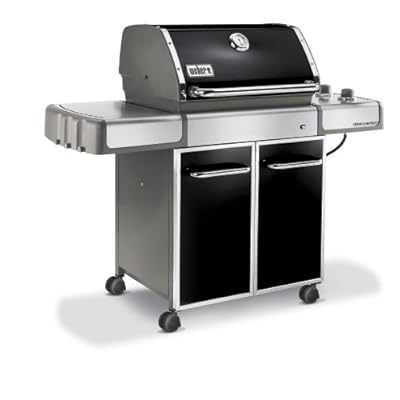
I found a grill which is more reasonably priced than the last one I drooled over. It's a 42,000 BTU Weber grill with over 500 square inches of grill space. Available in sleek black
for about $550 (or, for some unfathomable reason, for $700 in forest green
; note, I didn't say it was cheap), the Genesis E-310 Propane Gas Grill may eventually burn its way into my backyard.
This is made slightly more likely thanks to a gift certificate balance I have at Amazon; I got it by cashing in my coins at my local Coinstar machine. You'd be surprised how much money in coins you might have laying around! I read somewhere, many many years ago, that saving your change is a great way to generate "free" money. I never actually tried cashing those coins in until I was doing a house cleaning a few months ago and had nowhere to put the boxes of coins I'd gathered over the years (and moved from apartment to apartment). When I took the coins to my Coinstar machine the first time, I ended up with over $500.
The second time I ended up with over $300.
I now keep a jar at the door, and when it fills to the top, I cash it in. Normally, to get cash out of Coinstar, you have to pay a 9% fee of the total amount deposited. But if you get an Amazon gift certificate, that fee is waived. Ditto for iTunes gift certificates
, Starbucks, AMC Theatres, and nearly a dozen other merchants. It's a great way to recover your coins in one fell swoop.
And if a gift card to your favorite retailer isn't available, you can always get a prepaid MasterCard. Alas, that will cost you $10 just to get the card, and another $5 every time you renew it.
Nope, I'm sticking to Amazon gift certificates. Hello summer grilling season....
I love reading John Gruber's Daring Fireball. Witty, insightful, technical, it's one of the better Mac-oriented websites around. John comes across as a rather brilliant guy, but even the brilliant get it wrong on occasion.
This occasion was the title of a recent entry on his site. In lamenting the lack of a way to write programs for the Apple iPhone, John writes "iPhone SDK, iPhone SDK! Wherefore Art Thou iPhone SDK?" and makes a mistake almost everyone makes: thinking that wherefore art is "Old English" for where are. After all, in one of Shakespeare's most famous lines, Juliet cries out:
O Romeo, Romeo! wherefore art thou Romeo
But she's not asking "where are you, Romeo?" (despite the amateur productions you've seen of Juliet casting about from her garden window in search of a hidden Romeo), she's asking "why are you Romeo?".
: Juliet Capulet falls for Romeo Montague, but their families are sworn enemies. She can't be with him simply because of his name (awww). The lines that follow are
Deny thy father and refuse thy name; Or, if thou wilt not, be but sworn my love, And I'll no longer be a Capulet.
What Juliet is asking is why must Romeo be Romeo (and, unspoken, a Montague). She begs him to give up his family and his name, or if he's unwilling to do that, that they get married, and she'll take on his last name, and therefore give up hers.
I don't recall learning the meaning of wherefore in school; I learned its meaning sometime in the late 80s, while studying Shakespeare in my acting company (New York Parks' Shakespeare Company). (Although Romeo and Juliet wasn't one that I performed in, we studied famous scenes and plays as a way of better understanding Shakespeare in general.)
Wherefore as where is such a common misconception that it wouldn't surprise me if a poll of English teachers got it wrong; I know that most ordinary people you'd stop on the street would. The unfortunate thing is, in an incorrect use like "Wherefore Art Thou iPhone SDK," most ordinary people would get what you're trying to ask, which means this mistake will continue on, and, even worse, might gain currency as correct.
A few weeks ago, when we first saw the apartment Y moved into this weekend, she commented unfavorably on the lack of an elevator in this third-story walk-up. I retorted "you only have to worry about it twice: once when moving in, and again when moving out."
Man do I regret that. After helping Y move into that third-story walk-up, my body has rebelled. It claims I've pushed it too far this time. After the 7.5 mile walk last week, the last thing it needed, it insists, was another strenuous weekend. And yet I compelled it to lift dozens of heavy boxes, beds and bags up and down several flights of stairs for six hours on Saturday, including one particularly cumbersome Ikea sideboard.
In particular, my body is taking its anger out on my lower back, which feels like someone has placed me on a medieval rack and turned the wheel the wrong way, compressing my spine. After rising from a sitting or reclined position, I'm forced to walk in a half-crouch until my body relinquishes its grip around my midsection.
I'm also feeling it in my forearms, which feel like a hot poker was shoved into my wrists. I'm reminded of the exercises I used to do for my stage combat training: I'd take two fencing swords, extend my arms straight out to my sides, to my full wingspan, and describe ever-smaller circles with the tips of the swords. It only took a few minutes to feel the burning sensation. (Don't believe me? Give it a try with a couple of pens in each arm.)
I'm surprised my legs have been let off the hook. I was expecting my calf muscles have me in throes of agony, but I only feel a mild twinge, and usually only when I'm climbing the stairs. Indeed, I found walking up and down the stairs of the new apartment (as well as the hills of Y's SF neighborhood) almost refreshing.
Almost.
I've already decided: my next move, I'm hiring professionals.
During the damp, dreary darkness of California winter, I looked at buying a new grill. I enjoy grilling, and for most of the year, California has great grilling weather. Buying a grill during the winter is akin to buying a convertible during a rainstorm: salespeople are thrilled to see you and will give you a great deal.
Of course, I never bought that grill.
Now, with Memorial Day and the unofficial start of summer leaping upon us, I find myself again eyeing a new grill. Unfortunately, the one I'm eyeing costs $12,000.
OK, so I'm not really eyeing it so much as ogling it. Only in my wildest dreams (and exorbitant stock prices) could I even consider it. But, oh, it's so cool.
This mofo is huge: a 36" x 24" grilling area, 100,00 BTUs on the main burner, a Rotisserie, a side-burner with 22,000 BTUs, ready for wok cooking, a thermometer that goes up to 1,000 degrees, and, as you may have guessed by virtue of its highly descriptive name, it chars your meat with either charcoal or gas (or, oh! both at the same time!). Replace charcoal with chunks of hardwood and you've got yourself a mouthwatering smoked barbecue.
A few months back at my irregular vision checkup, I learned something that every woman I've met has known: I'm color-blind. Not severely, mind you, but enough that I'm unable to distinguish the number in the image to the side.
I believe I'm afflicted by "anomalous trichromacy", probably "Deuteranomaly", which, according to Wikipedia, means greens are weak and reds are stronger to my eyes, and affects 6% of men, . While it doesn't affect me in my everyday life, I found my "deficiency" interesting enough to try operating without the benefit of any color cues.
The easiest way for me to do this was on my computer, where it's dead-simple to turn off color. I launched System Preferences and opened Universal Access, a preference pane designed to make Mac OS X easier for disabled people to use. You can have your Mac speak the textual interface to you, make the entire screen bigger and reverse colors to white on black.
You can also turn everything grayscale, eliminating all color completely.
I lived without color for weeks (and consistently freaked out people who came into my office), and what I learned is most people have no idea how important color is in communications. Here's a typical iChat window, but in greyscale.
Can you tell who's available (green), who's idle (yellow) and who is away (red)? That's how many color-blind people see things. Here's that window again, in color:
Much clearer, isn't it? (Note, even in color I can't easily distinguish between green and yellow, and often have to give it a second glance.)
Fortunately, Apple tends to care about the issues of the disabled, and have thoughtfully put options into iChat to use shapes to distinguish state: circles for available, triangles for idle and squares for unavailable.
Not everyone is so considerate. Even Apple's Server Admin tool uses red and green icons to indicate status. In greyscale, it's nearly impossible to tell them apart, especially with no legend saying "this is what red looks like".
You'll find many transgressors in help manuals, where they'll ask you to, for example, "click the red button to stop recording".
(I've been keeping an eye open for poorly designed applications that use color as a primary interface, and I'm surprised to say I haven't encountered too many.)
I suggest living in greyscale for a few weeks to see how the other, uh, 6% lives. For the first few days, it'll feel weird, and you'll realize how important color is. After a while, switching back to color will either be a huge relief, or you'll find the color to be garish and bright. (The latter is what happened to me, and I had to get used to color all over again.)
You might also try software that simulates various color-blindness, such as Sim Daltonism or Color Oracle. It can be an eye-opener.
There are many ways of getting a file from your computer to someone else's computer: you can send it via email, from a web page, or upload it to .Mac's iDisk. But more basic than any of these is the aptly named File Transfer Protocol, or FTP. FTP is as integral to the internet as the web and for a long time was the primary way files were sent between computers.
Mac OS X provides for downloading from an FTP site (from Finder, choose Go > Connect to Server... and enter the address, e.g. ftp://ftp.apple.com), but surprisingly doesn't provide for a way of sending files (i.e. writing) to an FTP site. (And the download functionality is awfully slow anyway.) Why, I'll never understand. "Third-party opportunity," as they say.
Fortunately, there are many third-party developers filling this opportunity (a search on VersionTracker for "ftp client" returns some 40 applications). My favorite is Panic's Transmit ($18), though Fetch ($25) continues to be highly regarded, and Captain FTP ($25) has a strong following. If you'd rather not pay that much for an FTP client, CyberDuck is donation-ware (and donate you should).
The problem is if you click a link in your browser, instead of your FTP application of choice launching, Finder tries connecting to the FTP site. This often leads to great pain as Finder chugs through the connection and download, and too bad if you need to upload a file.
No, what you need is for your FTP application of choice (let's just call it Transmit) to be the default application for all FTP activity.
Here's how you do that.
First, download and install an FTP application. I use Transmit because it's fast, well-designed, and I like the company. Installing Transmit is a breeze. Download and open the disk image, and drag the icon to your Applications folder. That's it. Double-click the application to launch and register it with the system.
Then, you need to be able to change how your system treats FTP links. That means changing your system's default behavior, and unfortunately, there's no built-in way to do this. Why, I'll never understand. "Third party opportunity". Right.
In this case, that third-party is RCDefaultApp. And its most elementary level, it lets you decide which application opens when you click on, say, a web link, an email link, or, in our case, an FTP link. So download RCDefaultApp, open the downloaded disk image, and install it by double-clicking RCDefaultApp.prefPane
Since it's a preference pane, System Preferences will launch and ask if you want to install it for this or all users. Choose "Install for this user only" and select "Install".
Aside: You may get another message saying "The preference pane you are installing is already installed. Do you want to replace the existing preference pane?" Fight your urge to say "OK", and instead choose "Cancel". There's a bug that prevents the preference pane from being installed if you say "OK". I've reported it to the developer.
Once installed, the prefpane shows up as "Default Apps" (look under "Other" if you're organized by category). Click Default Apps and note the options under "Internet".
Select FTP, then click the popup under "Default Application" and select your chosen FTP application (in this example, Transmit).
Quit System Preferences, and the next time you click an FTP link, your FTP application should open automatically. Go ahead, try it: ftp://ftp.apple.com.
RDefaultApp isn't just for FTP applications. It can also be used to enhance security by preventing certain internet URLs, file extensions and file types from opening an application. We'll talk about that in a future article.
This Friday was Y's big 3-0, and we celebrated throughout the weekend. On Friday, a small group of friends had dinner in a new Chinese restaurant, followed by Shrek The Third at a new movie theatre. What better way to enter a new decade than with new experiences?
Saturday was the full celebration, with 16 of Y's friends enjoying dinner at a local Italian restaurant. There was a lot of food, and a lot of leftovers. It was fun pulling together different groups of her friends and watching them enjoy each others' company. We also enjoyed a few good bottles of wine. I'll have to get the names.
The weekend culminated in our participation in an annual San Francisco tradition, Bay to Breakers, a 12 kilometer (7.46 miles) footrace that's been going strong for 96 years. About nine of us took a leisurely stroll through the streets of San Francisco, including a hill with an 11.15% incline, before wandering through Golden Gate Park and ending up in front of the Pacific Ocean. Many of us wore "Over the (Hayes Street) Hill, 2007" tee-shirts I had printed up for the occasion.
At the top of Hayes Street Hill, we sang Happy Birthday to Y, much to her surprise and chagrin.
The weekend ended much as it had begun, with us eating a late lunch together, this time at a Thai restaurant, before we made our ways home.
The legs of this particular "over the hill" walker are now in some pain, as you might expect of legs which don't see much physical action anymore. I took a brief hot bath soak in my jetted tub to relieve the tension, and will definitely be applying some Ben Gay or something shortly.
If you've never experienced Bay to Breakers, I strongly recommend you do. It's a one-of-a kind event, with both serious runners and leisurely walkers, and everything in between. There are outrageous costumes and stark nakedness, freely flowing alcohol and staid Jesus-Loves-You/Hates-Gays follies. It's a genuine microcosm of Life In San Francisco.
On final note, this year Bay to Breakers had a timing chip that gave your start-to-finish time, to the second. Our walking time was 3:21:18. Whoo.
I still own and use Apple's first iPod Shuffle (the long, white one that holds 240 songs or a gigabyte of data). I find it extremely convenient for shuffling files (not music) between machines, especially if there's no network available or the data is too big for email. I thought at the time that for $99, they were tantalizingly close to the give-away-the-device price-point, where you would, for example, buy a music album that came on the iPod Shuffle, not on CD.
More interestingly, non-music-playing memory sticks that sold for $30 or $40 a few years ago were likewise almost at the throw-away-device stage: toss some data on it, flip it to the recipient, and walk away. No need to get the device back. But the price would have to drop to under $10 to make that truly viable.
A co-worker has been making the rounds, showing off his latest cool gadget: a tiny USB memory stick, capable of storing 2GB of data. The Kingmax Super Stick
is literally smaller than a paperclip, consisting of just the USB connector and the memory chip.
Nine bucks for a gigabyte of data, in a tiny, begging-to-be-tossed-in-the-wash device.
I've been enamored of the concept of disposable storage devices ever since I read my first cyberpunk novels some 15-plus years ago, in particular the Shadowrun series of novels (especially the ones by the late Nigel Findley).
The stories were filled with shadowy underground operatives working the Matrix (think body-modded hackers on a future Internet). Payment for services rendered wasn't cash (that was illegal) or credit cards (that left a data trail), but small, disposable devices keyed with a set amount of money. The recipient plugged the device into a system, punched a few keys, and his bank account grew appropriately.
With these miniscule drives steadily shrinking in size and price for the last few years, I've been impatiently waiting for the day when disposable storage devices became a reality, and now that they're here, I'm breathlessly waiting for someone to create a way for me to "pay" someone by giving them a coded memory stick.
Anyone want to make this a reality?
Note: Good luck finding copies of these books. They're 15 years old, and an intersection of a sub-genre of a sub-genre of sci-fi and role-playing games. They didn't have huge sales even in their heyday. If you'd really like to read one or two of these, Amazon sellers have (mostly used) copies
. Your local well-stocked library may also do you well. There are also a couple of newer story-lines
The Digital Millennium Copyright Act (DMCA) was signed into law by President Clinton in 1998 to disseminate and protect the arts in the digital age.
We just heard about this "DMCA" thing today, and thought we'd see if it could make us money.
It makes illegal and prohibits the manufacture of any product or technology that is designed for the purpose of circumventing a technological measure which effectively controls access to a copyrighted work or which protects the rights of copyright owners.
Don't make stuff that only exists to steal stuff. That's wrong.
Under the DMCA, mere avoidance of an effective copyright protection solution is a violation of the act.
If you don't stop the crime, we'll make you do the time.
MRT and BlueBeat have developed a technological measure which effectively controls access to copyrighted material.
Wait a minute! We make "effective" copyright protection solutions. A loophole! A loophole!
That product, the X1 SeCure Recording Control,
We love unNecessary inTercaps.
has been tested by the industry's standards bodies, the RIAA and IFPI, and has been proven effective against stream ripping, while protecting privacy and limiting infringement liability for users, distributors and academic institutions.
It has been designed for rapid deployment on a reasonable and non-discriminatory (RAND) basis.
Anyone can use it, it's cheap. Prices so low, we're practically giving it away.
Therefore, Media Rights Technologies (MRT) and BlueBeat.com have issued cease and desist letters to Microsoft, Adobe, Real Networks and Apple with respect to the production or sale of such products as the Vista OS, Adobe Flash Player, Real Player, Apple iTunes and iPod.
No one wants to buy our stuff. Maybe legal departments of billion dollar companies are easier to contact than their procurement departments?
MRT asserts Apple, Microsoft, Real and Adobe have produced billions of these products without regard for the DMCA or the rights of American Intellectual Property owners, actively avoiding the use of MRT's technologies.
Next up: we're suing car drivers for using generic gas rather than Chevron with Techron. Don't you care about protecting your car's engine?
Failure to comply with this demand could result in a federal court injunction to any of the above named parties to cease production or sale of their products and/or the imposition of statutory damages of at least $200 to $2500 for each product distributed or sold.
Nice business you got there. Be a shame if something happened to it.
"Together these four companies are responsible for 98 percent of the media players in the marketplace; CNN, NPR, Clear Channel, MySpace Yahoo and YouTube all use these infringing devices to distribute copyrighted works," states MRT CEO Hank Risan.
We're not after the gold diggers, we're after the pick-axe makers. Same reason to rob banks.
"We will hold the responsible parties accountable. The time of suing John Doe is over."
With a title like that, you almost have to click through to read it. I did a few weeks ago when it came across my newsreader, and ended up on the website of Tim Ferris, where he was talking about his forthcoming book The 4-Hour Workweek
, subtitled "Escape 9-5, Live Anywhere, and Join the New Rich".
I ended up spending about 30 minutes trawling through his website, intrigued if suspicious. One of a million people selling "lifestyle redesign". Work less, make more. Blah blah blah. Heard it all before.
But he had an interesting take on things. He gave an example of "outsourcing" your life to, say, someone in India working as your personal assistant. Bills, research, difficult phone calls to your cable provider. All for maybe $5 an hour.
Perhaps you then choose to live in an inexpensive part of the world, maybe Buenos Aires, and generate income in the U.S. So you're making American dollars, paying Indian wages and Argentinean expenses. A true "global economy".
Hey, that sounds kind of fun!
I've mentioned this book to a couple of friends in conversation. E thinks it's hokum; he likes living in the Bay Area, for example, and doesn't mind spending 20 minutes paying his bills. Others are likewise intrigued but believe it's just another get-rich-without-trying scheme.
It's 6:48pm and I (and my entire complex, and, it seems, much of the area) am without electricity. I have a couple of battery backups, and I have my Airport Extreme and DSL modem plugged into one of them. I'm posting this from my trusty MacBook.
Power has been gone for about 25 minutes now, and PG&E have indicated they "know" about the problem. They expect to have power back "between 6:15pm and 8:30pm". We shall see....
I lost power twice in the span of twenty minutes, earlier today, each time under a minute. Enough to shut down my TiVos rather rudely. I hope the drives don't get corrupted.
I have a fair amount of food in the fridge, so I'd rather not be without power for too long. I'm chatting with my friend JS in New York as this happens, and she mentioned that ConEd in NY paid for the loss of her food and any damaged appliances, but I doubt PG&E would do the same. Something to investigate, should it become necessary.
In the mean time, I've flipped all the switches in the fuse box to protect my stuff in case of a power surge when electricity finally comes back.
Update, 7:15pm: Power delayed. Automated call from PG&E stating power is estimated to return between 8pm and 10pm. Sigh.
Update, 8:10pm: Power restored. Automated call from P&E informs me power has been restored. Unfortunately, I'm out looking for dinner. I had to hand-open my garage to get my car out. Funny how much stuff around us stops working without electricity.
Update, 8:30pm: Finally back at the house. Lights are on across the complex. Whew. Off to flip the circuit breakers, power on the servers, and post this.
One of the few issues of getting a Nintendo Wii, especially in the early days of our Wiinfatuation, was the constant changing of the remote's pair of AA batteries. For a while it seemed like we went through a two or three pairs a month. I thought of buying a set of rechargeable AAs, but still didn't relish the idea of swapping out batteries every few weeks to recharge them.
. No need to swap batteries, just stand the remotes on the station and boom! automatic recharging.
Unfortunately, when I read about it, the product was still months from being released. When my buddy THW noted a few weeks ago that it was available at Fry's, I kept an eye out for them, visiting various Fry's and Best Buys, without success, until last night, when I found myself killing time at the Palo Alto Fry's.
At only $30 for the ability to charge two remotes, and save untold amounts of money (and landfill space) going through batteries, buying a set was a no-brainer. Most of THW's points from his report stand for me, except I find the handling of the wrist straps on the remotes to be poorly thought out: if there's a groove for them, they are not obvious on my system, and having to put them just right to charge the remotes was a tad annoying. Having the lights though does make it less frustrating than it would otherwise be, and no doubt I'll get used to finessing them.
At four AA batteries per pair, and eight batteries a month, I figure I'm saving close to $100 and 100 batteries a year. A win-win for my wallet and the environment.
My new concern? Running down the battery charge in the middle of a marathon game of Wii tennis, and not having extra batteries....
Today Apple posted another Steve Jobs essay, this one about how Apple strives to create products that are environmentally friendly. Apple has been getting beat up in the press about the Mac and iPod maker's supposedly poor environmental policies, thanks in great part to Greenpeace's campaign against the company.
In his essay, Jobs notes that
So today we're changing our policy.
Anyone with a grade-schooler's reading comprehension will see that "today we're changing our policy" is in reference to Apple policy not to "trumpet our plans for the future".
So what does Greenpeace do? They post a headline on their Green My Apple site that says "Breaking News: Steve Jobs" announces change in policy", and an essay of their own:
You're the consumers of Apple's products, and you‘ve proven you make a real difference. You convinced one of the world's most cutting edge companies to peel the toxic ingredients out of the products they sell.
They've deliberately taken out of context Jobs' comment about policy change, and state that this change" is about eliminating "toxic ingredients".
How lame.
That's not all, though. In their opening paragraphs they also say
Apple has declared a phase out of the worst chemicals in its product range, Brominated Fire Retardants (BFRs) and Polyvinyl Chloride (PVC) by 2008. That beats Dell and other computer manufacturer's pledge to phase them out by 2009. Way to go Steve!
Factually accurate, but purposefully misleading. Reading this, you might draw the conclusion that Apple said "we're changing our policy to eliminate BFRs and PVC by 2008". In fact, what Apple said was
[...]
Today, we've successfully eliminated the largest applications of PVC and BFRs in our products, and we're close to eliminating these chemicals altogether. For example, more than three million iPods have already shipped with a BFR-free laminate on their logic boards.
[...]
Apple plans to completely eliminate the use of PVC and BFRs in its products by the end of 2008.
[...]
Apple's plastic enclosure parts have been bromine-free since 2002.
Much different take, wouldn't you say? Apple choose to "phase out... the worst chemicals in its product range" six years ago for BFRs, and twelve years ago for PVC! And while some computer manufactures still use BFR for some of their plastic enclosures (Jobs mentions Dell specifically), Apple completely eliminated BFRs from their plastic enclosures five years ago.
I'm disappointed in Greenpeace. While I applaud their efforts to reduce the environmental impact companies make, it's unfair to use misleading tactics to accomplish this goal. Apple appears to be as green as—if not more so than—any of its competitors, and calling them out smacks of opportunism: Apple is a media darling, draws headlines, and has millions of famously loyal customers.
Using Apple as the poster child for the industry garners Greenpeace more interest than using Dell or Gateway. I find that a sleazy practice and wish Greenpeace would just fight fair.
For the last year or so I've been trying to follow David Allen's Getting Things Done methodology, with varying levels of success. One reason for the less-than-stellar progress is a lack of a "trusted system" into which all my projects, tasks and "next actions" go.
and a Tul pen everywhere to do the "ubiquitous capture" that's so important in GTD, but transferring those captured ideas, reminders and notes into something permanent has ben missing. I need a system on my computer into which I stuff these written items, along with those I think of when I'm at my computer (most of the time).
I've tried a bunch of stuff. Kinkless GTD (kGTD), iGTD, Actiontastic, and on and on. Each has some killer feature and, more importantly, some fatal flaw.
Today I may have found my holy grail, and I'm ready to plunk down my credit card. Two problems: I haven't used it and it's not shipping yet.
So why am I ready to part with my plastic? Because I saw a video of it in use, and it does everything I want. From capturing information to making tasks into projects ("bake a cake" isn't a single task, it's a project with a series of tasks) to showing only the "next action" in a series of actions (I can't "buy ingredients" until I "find a recipe").
The application is OmniFocus, from The Omni Group, creators of OmniOutliner, one of the better outliners on the Mac, and other fine Mac-only apps. Kinkless GTD is based on OmniOutliner. It's a bunch of AppleScripts that drive OmniOutliner in a GTD-like manner. It works, but it's clunky: for example, you have to press a "sync" button whenever you make changes to your list of tasks.
Ethan Schoonover, the creator of kGTD, worked with The Omni Group to rework the kGTD idea into a real application, and the results, even in early alpha, had me slapping my hands and shouting in delight. I absolutely cannot wait to get my hands on the product and give it a spin.
Whether I'd become more organized is debatable, but I'd have one less excuse for it.
Recently I moved Jasonian.net from the Mac behind my DSL line to a "real" webserver at Dreamhost. For some reason I don't remember, this required me to make a change in Ecto, the tool I use to write and publish to Jasonian.net, and in doing so, I lost all the drafts of articles or ideas I'd written but not published.
Aarrgh!
I searched the Ecto forum and found many others complaining about lost drafts. The only solution presented was by the developer, suggesting we send him a pair of files and he'll try to reconstruct the missing entries. Although appreciated, it didn't sound promising.
Ecto had made a backup of the "working" file when it created the new file (thank goodness for small favors, it turns out). Simply renaming the file from "entrydata_backup.plist" to "entrydata.plist" didn't work, even though when I opened the .plist file in BBEdit I could see all the drafts there. I decided to poke around the files a bit.
I tried copying an entry from the backup to the main file, and it didn't show up. It took a couple of minutes of poking around but I eventually did notice that some of my draft entries were listed in one tag as
Hm. Could a simple "www." make a difference? Yes! If I copied an entry to the main file with "www.jasonian.net", it didn't show up in Ecto, but did show up as "jasonian.net"! A few more minutes in BBEdit finding and replacing appropriate entries, and voila, all my drafts were back!
This method may not work universally, but if your drafts disappear, check to see if your url key is set to something other than what you expect.
MacLockPick is a $500 USB flash drive from SubRosaSoft. It claims to be
a valuable tool for law enforcement professionals to perform live forensics on Mac OS X systems.... with as little interaction or trace as possible.
You insert the USB drive into a Mac, run some software, and it will copy a bunch of sensitive information to the flash drive. Among the information copied:
the user password of the logged in user
passwords for encrypted disk images, iTunes music store and iChat login
login and passwords for web sites, email accounts, online stores and .Mac accounts
a list of all the key user folders, with their creation dates and date of the most recent access
paths to files opened in the Preview application
recent applications, documents and servers
contacts stored in Address Book
search terms from Safari's Google search bar
Safari bookmarks
web cookies, which may include login information to secure sites
web browsing history
Wow. That's a phenomenal amount of sensitive information available. Is it possible that you can thwart such a device with two mouse-clicks?
The device "is not for sale to the general public" and anyone buying it must prove they "are a licensed law enforcement professional". No word on what proof is required. (I got to the point in the order process where I was asked for my eBay payment information, without any request for some kind of proof.)
From what I can tell (there is understandably little detailed information on SubRosaSoft's website), much of the application (all the password stuff) works by taking advantage of Mac OS X keychain's default settings. You, Mr. or Ms. Mac user, have a "keychain" that stores all of your logins and passwords, and an application (called, intuitively enough, "Keychain Access") to manage those items. You only have to remember one password (the keychain's) instead of dozens or hundreds of individual ones, and application developers don't have to write dozens or hundreds of different ways of storing secure information: they just use the keychain.
By default, when you log in, your default keychain is unlocked for you. It re-locks automatically after your computer's been idle for some time. The keychain resets to the default "unlocked" setting when you wake your computer from sleep. This means if the keychain happened to be locked when you put your computer to sleep, it will, by default, be unlocked upon wake.
This is meant as a convenience to you: when you're actively using your computer and an application needs a stored username or password, the application gets that information from the keychain without interrupting your work. When you're not using the computer actively, the keychain is locked, protecting your secure information from casual attackers.
This convenience appears to be the vector SubRosaSoft uses for MacLockPick:
Once awakened a Mac will return its keychain access levels to the default state found when it was initially put to sleep. Suspects often (and usually) transport portable systems in this sleeping state.
If my assumption is correct (I've asked SubRosaSoft to confirm or deny this; I'll let you know if I hear back), thwarting MacLockPick is as simple as checking two boxes in the Keychain Access (found in /Applications/Utilities):
You'll find these checkboxes in Keychain Access under the Edit > Change Settings for Keychain "login" menu.
The first checkbox ("Lock after # minutes") will lock your keychain after the set period of time. After five minutes (in this example), any application needing access to your keychain will result in a prompt for your keychain password.
With the second checkbox ("Lock when sleeping"), applications needing access to your keychain after your machine's awoken from sleep will likewise prompt for your keychain password.
Both items make it more likely that at any given period your keychain is locked, and therefore unaccessible to applications without your direct intervention. What you lose in convenience you gain in security. (And yes, actually setting this to five minutes will certainly drive you batty if your applications need stored passwords a lot.)
Why would I write about a way to potentially thwart a supposed law enforcement device?
First, the default settings for Keychain Access are less secure than they could be. Clearly Apple made a conscious choice here, coming down on the side of user convenience in leaving the two options off by default. That's probably the right choice, one I've never had the need to rethink until now.
Second, I'm merely pointing out two checkboxes Apple has included in Keychain Access. They're clearly there for those who wish to enhance their computer's security. In fact, the National Security Agency (NSA) Systems and Network Analysis Center (SNAC) have this very recommendation in their "Mac OS X Security Configuration For Version 10.4 or Later, Second Edition".
If this method prevents covert access via MacLockPick to sensitive information (and I still don't have confirmation that it does), law officials will still have other methods of accessing the information, while I have some piece of mind that MacLockPick won't be misused on my machine by some unscrupulous guy sitting next to me in a coffee shop.
Unfortunately, this would still leave much of your sensitive information ripe for the picking. Enabling OS X features like Safari's Private Browsing, or the use of encrypted disk images come to mind immediately. I would suggest a thorough reading of the NSA/SNAC security configuration guide. I'll write about some of my security escalation plans in the next couple of days.
Deeper-geek aside: The piece I'm unsure about is how MacLockPick has access to your keychain information without you giving it access. Any application can write to an (unlocked) keychain, but requires permission (in the form of asking for your password) to access any keychain item other than its own. It's possible SubRosaSoft is bypassing the keychain APIs and using a much lower-level set of functions (the open source Common Data Security Architecture (CDSA) and the Common Security Services Manager (CSSM), which the keychain protocols are built on).
I'll be looking into this detail using Apple's Developer Connection website, where documentation on reading and writing to and from the keychain is available for application developers.
Every recent AAPL quarter has blown me away. This quarter, Apple sold 1.5 million Macs and 10.5 million iPods, and made $5.26 billion, with a profit of $770 million ($0.87 a share). That's three months of sales. Last year at this time, Apple had sold 1.1 million Macs and 8.5 million iPods, and made $4.36 billion and a profit of $410 million ($0.34 a share).
Wow.
AAPL reacted after hours, shooting up to $103 a share, before settling down to about $100 a share. Thursday's opening and trading session should be very interesting. Will it open over $100? Will it trade higher, or lower?
I don't want to hear your crappy choice of songs when I visit your site.
If you're going to force me to listen to your music, to the point where you won't even offer a mute button, I'm not going to spend much time on your site.
That means I'm not going to buy your product or use your service.
Are you listening, EverBank? Your web tour, with its GarageBand-y pop-synth soundtrack, stopped me from seriously considering you as a replacement for my banking needs.
Do you hear me, Canto Do Brasil? I won't be bringing 20 people to a celebratory dinner thanks to your 17 tracks of midi music.
If you want to give me the option of listening to your music, that's fine, but put a god-damned mute button on your site!
E*Trade is starting to work my last nerve. Yesterday I got an email from them:
Fri Apr 20 06:30:35 2007 - Funds Transfer Failure
Dear Valued Customer
Your payment request (Reference Number:########) of $### to E*TRADE Bank XXXXX from your XXXXX could not be completed.
Their website was equally unhelpful.
I sent in a customer service inquiry:
Can you tell me why this transfer failed? There is certainly enough money in the account.
A few hours later, they responded:
Thank you for your recent message in regards to a transfer from your XXXXX account to your XXXXX account. I would like to inform you that there was an error during the transit of the funds on 04/18 which caused the transfer to be cancelled. I apologize for any difficulties or frustrations this transaction may have caused. Please resubmit this transfer for further crediting to your XXXXX account. Please feel free to contact us if you have any further questions or concerns. Thank you for your valued and continued business.
I hope this information has been helpful. Please let us know if we've addressed your questions and concerns satisfactorily by taking a 30-second survey at the following web address:
At which point they helpfully provided a survey.
They didn't score high.
After fuming for a few minutes over the non-answer response, I replied back:
"There was an error" is understood by the error message I received. I would like to know why I received it, and why the $### to be credited to my ##### appears to have been deducted.
Did the transaction fail or not?
I show a $### deduction on 4/19 ("Etrade Bank Debit").
My XXXXX shows a "Last Payment Received" on 4/18 of $###.
I'm extremely concered about the system's behavior, and I'm extremely concered that my accounts are being incorrectly managed.
This is not the first time I've received error messages for problems that seemingly didn't happen. I need an exact explanation of what happened, and why.
And it's true: it's not the first time E*Trade has told me a transaction didn't complete, that I didn't have enough money in my account, or some other error that turned out to be utterly false. The last time it happened, it was an overdraft notice (when I had significantly more in the account to cover outstanding debits), and I was told
Please note that this is not an isolated incident. We have been upgrading our systems in order to provide the best services for our customers. The technical team is working assiduously to correct these issues. We appreciate your patience. We value your business very much.
If you really valued my business, you wouldn't be rolling out new systems that cause known problems.
If it weren't for the fact that my company uses ETrade to manage its Employee Stock Purchase Plan, I doubt I'd remain with ETrade much longer. Do you know of a good online bank? It needs the following features:
Free, unlimited and automatic ATM refunds. The other big reason I'm with E*Trade still. I can use any ATM in the world, and be refunded the access fee (even the $4.50 I was charged in Vegas!). Other places have a similar plan, but some limit the number of refunds in a month, while others require you fill out a form of some type.
Great online banking. I don't do physical banks anymore, except to deposit the occasional paper check, so an easy-to-use and comprehensive functionality is important. That means easy transfers between internal and external accounts; recurring payments; a smart calendar that tells me when a payment will be delivered; and various reports.
Any suggestions for a great online bank would be much appreciated.