
Automating STOP to End⚙︎
You’ve undoubtedly received text messages seeking political donations or exhorting you to vote a certain way. Most conclude with Stop to End, Stop2End, Stop to Quit, and similar stock phrases to request removal from their list.
I always reply Stop because I can’t abide unsolicited solicitations. I’ve wished I could automate it.
Brad Greenlee, in March:
It took three of us to figure out Shortcuts’ arcane UX, but we managed to automate “STOP to end”
The method is only for iOS; it uses a Shortcuts Automation to respond to messages containing one of the magic phrases, and, as Brad notes,
Setting it up is completely non-obvious.
An understatement. In fact, the important UI is completely hidden—first behind a long press, and then behind a second tap. Kudos to the three of them for discovering how to do this.
Fortunately, their walkthrough is easy enough to follow. The biggest hassle is that you must repeat it for each phrase, and for every device: You can’t duplicate an Automation, you can’t share them, and they don’t sync across devices.
(The second biggest hassle is that Shortcuts is buggy, at least on my main device. I can’t delete an Automation (FB14246121), and icons blink for no reason (FB142246569). Things work fine on a duplicate device, and in the betas.)
(Via Kris Arnold.)
ChatGPT and the Fake History of Skee-Ball⚙︎
Yours truly, on the pattern-based bullshit of AI chatbots:
Our acceptance of this BS as truth is dictated both by our knowledge of the topic at hand and our personal level of skepticism.
My friend (and former colleague) Thaddeus Cooper, after spending multiple hours querying ChatGPT about the history of Skee-Ball:
So far, ChatGPT has:
- misidentified the inventor of Skee-Ball
- created references to a non-existant game called Newcomb’s Parlor Table
- incorrectly identified the authors of “Seeking Redemption: The Real Story of the Beautiful Game of Skee-Ball”
- stated that the book “Seeking Redemption: The Real Story of the Beautiful Game of Skee-Ball” contains a section talking about Newcomb’s Parlor Table, which it doesn’t
- invented two articles that never existed AND provided fake links to those articles
- and finally, it produced a third article and attributed the website to the American Skee-Ball League (which doesn’t exist) in supporting evidence of Newcomb’s Parlor Table.
Thad’s conclusion:
This lengthy interaction shows that it will make up information at will and present it as fact. And, when asked to produce a source it will fabricate one for the fake information. The AI researchers have a name for this. They call it hallucinating. Frankly I call it lying.
ChatGPT picked the worst person to lie to about Skee-Ball. Thad is the co-author of Seeking Redemption: The Real Story of the Beautiful Game of Skee-Ball, a “464 page tome” about the game. There may be no one on the planet more knowledgeable about its history.
Lies, Damned Lies, and AI Hallucinations
I’m a big fan of the TV show Frasier. I’m now halfway through my third or fourth rewatch.
I was thinking recently of an episode, and wanted to look it up. I recalled the plot, and my first thought, as it is for most people seeking answers to simple trivia questions, was to turn to my nearest search engine. But I wasn’t sure how best to word the query, so I thought I’d give ChatGPT a shot, as I’m always looking for reasons to explore its capabilities. I could ask it in plain English, and as it’s likely slurped up all of IMDB.com, frasier.fandom.com, Wikipedia, and so on, it should have a comprehensive grasp of television episode facts.
Whoo boy, was I wrong.
ChatGPT, if you don’t follow the news, is an artificial intelligence chatbot powered by (it says in its self-description) a “vast amount of text from the internet, books, and other sources.” You type or talk in plain language, and thanks to fast computers and fancy math, it can “mimic human language patterns and provide relevant and coherent responses.” It’s often used to polish prose, write code, or brainstorm ideas.
It can also answer questions.
So I asked ChatGPT if it was familiar with Frasier. Things started out great.[1]
Yes, I’m familiar with the TV show “Frasier.” It is an American sitcom that aired from 1993 to 2004. The show is a spin-off of “Cheers” and follows Dr. Frasier Crane, a psychiatrist who moves back to his hometown of Seattle and becomes a radio show host. The show features his interactions with his father Martin, his brother Niles, his producer Roz, and other characters. It is known for its witty dialogue, sophisticated humor, and strong character development. If you have any specific questions or need more information about “Frasier,” feel free to ask!
Cool, spot on. Let’s dive in.
There is an episode where Frasier and his brother Niles share an office, and have trouble working together. They are mediated by a fellow doctor to reconcile their working relationship. Are you familiar with that episode?
Yes, the episode you are referring to is titled “Rooms with a View” from the tenth season of “Frasier.” In this episode, Frasier and Niles decide to share an office space but soon find that their different working styles and personalities lead to conflict. They seek the help of a mediator, another doctor, to help them resolve their issues and find a way to work together harmoniously. The episode showcases their sibling rivalry and contrasting personalities, leading to humorous and insightful moments.
Hm. That description is right, but I was pretty sure it was from earlier in the series, season 3 or 4 perhaps. So I looked up “Rooms with a View” on IMDB and Frasier Fandom and nope, that episode, s10e8, wasn’t the right one. I said so.
No. Rooms with a view is about Niles having open heart surgery.[2]
This is where things got absurd.
I apologize for the confusion. The episode you’re referring to is likely “Sharing Kirby,” which is in the ninth season of “Frasier.” However, it doesn’t quite fit your description. Let me correct that:
The episode you’re thinking of is “Bristle While You Work (Part 1),” from Season 10, Episode 4. In this episode, Frasier and Niles share an office space and struggle to work together due to their clashing personalities and work habits. To help mediate their conflicts, they bring in Dr. Schachter, a professional mediator, to assist them in reconciling their working relationship.
First, it apologies, giving an impression of contriteness and a determination to do better.
It again offers a correct description, and the doctor’s name is also right. “Sharing Kirby” is, in fact, a Season 9 episode, and it even recognizes it’s the wrong episode and corrects itself.
But oh! the confidence of its self-correction: “The episode you’re thinking of is....” Not “might be,” “is likely,” or any such qualifiers.
Yet despite its confidence, it’s also doubly wrong! s10e4 is “Kissing Cousin”, not “Bristle While You Work”; that’s actually s10e7.
Some people might call these incorrect answers “alternative facts.” The preferred term in some circles is “confabulations,” but the popular term is “hallucinations.”
I don’t like that term. It ascribes a humanity and basis in reality these tools simply don’t have, as if it’s a benign sensory mismatch to be indulged, like your doddering Uncle Jack swatting at unseen insects.
But there is no humanity in a bot, and “hallucination” mischaracterizes its impact. When Uncle Jack dodges mosquitoes that aren’t there, you might tut-tut in sympathy, but you don’t run to the corner store to pick up a can of Flit. Only Uncle Jack is affected by his hallucinations.
As much as a quarter of what these AI chatbot and search tools generate is factually incorrect. When it’s a wrong TV episode, the worst outcome is you look foolish in a pub trivia game. When they suggest you eat rocks or add paste to your pizza sauce, you may chuckle and move on, but this trivializes the issue. An AI “hallucination” is potentially deadly.
People have learned to trust the results of search engines and, by extension, chatbots. If it’s at the top of the results, it’s the “best link.” If you get a confidently written response from a bot, it must be correct. Because computers.
But this trust is misplaced because AI chatbots and search engines aren’t fact-based. They don’t know the “right answers.” They make shit up. They are, fundamentally, token prediction machines.
Imagine you have a deck of playing cards, arranged just so:
A♣️ 4♥️ 7♠️ 10♦️ K♣️ 3♥️ 6♠️ 9♦️ Q♣️ 2♥️ 5♠️ ???
Based on the pattern, you can probably predict the next card in the sequence[3]. Combined with some clever patter, you can convince people you’re psychic.
AI chatbots perform similarly. The sequences and predictions are infinitely more complex, and—because those sequences are words and sentences—the responses seem human. But it’s all pattern-based bullshit.
Our acceptance of this BS as truth is dictated both by our knowledge of the topic at hand and our personal level of skepticism. When delivered confidently, we’re even more accepting of its veracity. A plausible response stated as fact, and which matches our expectations, registers as true.
If it feels right, we accept it as right.
Back to my Frasier queries, where ChatGPT continued to confidently give me wrong answers. In one it wrote:
I apologize for the continued errors. The episode you are referring to is “Sweet Dreams,” Season 5, Episode 24. This is the correct episode where Frasier and Niles share an office and face difficulties working together, eventually seeking the help of a mediator to resolve their issues.
“The episode you are referring to is… This is the correct episode.” No qualifiers, no hedging, just straight-up stated as fact.
Imagine conversing with someone who lied with such unabashed conviction? You might feel compelled to believe him[4]. You can’t be that confident and be wrong! Yet the only thing right about this response is that s5e24 is in fact called “Sweet Dreams”. But, “this is the correct episode.”
It’s like being gaslighted by an apologetic psychopath.
I eventually gave up and found the episode myself[5], and asked ChatGPT one final question.
Are you familiar with s3e2?
To which it confidently replied
Yes, Season 3, Episode 2 of “Frasier” is titled “Shrink Rap.” In this episode, Frasier and Niles try to collaborate on a book about sibling relationships, but they struggle with their differing personalities and viewpoints.
They seek the help of Dr. Honey Snow, a family therapist, to assist them in overcoming their differences and completing their project.
Sigh. The “book about sibling relationships” is from s1e22 (“Author, Author”). In “Shrink Rap” they seek the help of Dr. Schachter, not Dr. Honey Snow—who wasn’t a family therapist, and wasn’t in either s3e2 or s1e22; she was in s2e15, “You Scratch My Book...”.
But it got the title right!
You can read the full transcript, complete with my continued misspelling of “Frasier”. ↩︎
With apologies for spoiling a 22-year-old sitcom episode. ↩︎
8♦️. This is the Si Stebbins Stack. ↩︎
It’s almost always a “him.” ↩︎
Turns out a Google search for “Frasier and Niles share an office and don’t get along and use a couples’ therapist to help” got me there. 🤷🏽♂️ ↩︎
James Earl Jones reads Frederick Douglass’s “What to the Slave Is The 4th Of July?”⚙︎
I meant to post this yesterday, but it’s never a bad day to listen to this powerful speech, made more powerful still by the emotive baritone of James Earl Jones.
A wonderful annual tradition.
Happy Birthday, America
Wow, 248 years old! Just a couple more until the big 250! I know you’re already busy planning a huge semiquincentennial.
I hope you make it.
I know, I know, technically you’re only 236 if we count from the ratification of your Constitution, but you know we all like to count your Declaration of Independence as your real birthday.
(Admit it, you prefer that too.)
However you count, you’re still the oldest living democracy. Even Athens, your birthplace, didn’t make it past what, two hundred? And here you are closing in on a quarter millennia!
Remember when you were, what? 165, 166? You went off with your friends to fight Nazism. You were a Big Damn Hero back then. Can you believe after all that effort, Nazism is making a comeback, right here at home?
By your 200th, you’d finally started to recover from that fight, and your unfortunate “excursions” into South Korea and Vietnam, and were looking to put the legacy of Jim Crow behind you.
Though I guess Jim Crow never really went away, huh? It just sort of became... institutionalized.

We both thought you’d finally overcome that legacy when you turned 232, but just eight years later, you suffered what looked like an allergic reaction. You were so angry all the time, so divided. All of us feared you were nearing the end. We weren’t sure you’d even make it four years. Then you got real sick, and had to isolate yourself for a while. Those were some dark, dark days.
Though the fever broke, many of the symptoms persisted. There was that unprecedented flareup the January you were turning 245. That one really scared us. We thought for sure you were a goner.
To be brutally honest, the last seven or eight years feel a lot like it did when you were in your early 80s, and we’re not only worried about another episode like the one you had when you were 85, some people are explicitly threatening us with it. Just imagine, people want to put you through that again. You almost died then, you’re unlikely to survive another.
It might be time to take a good, long look at yourself in the mirror and be honest about how you got sick then, and how it’s still impacting you today.
Yes, sadly, you’re still very sick. Your major institutions are failing, and your little cousin, the Fourth Estate, is collapsing with you.
But as ill as you are, you’re also strong and determined. You’ve weathered so much. You’ve tossed aside kings, courts, and wannabe tyrants before.
And we have good people working to heal you. It’s touch-and-go right now, but we must have faith in you.
So, happy birthday, America. Hang in there. See you at 250.
⚙︎Rudy Giuliani disbarred in New York
Politico:
Rudy Giuliani has been disbarred in New York for his efforts to subvert the 2020 election.
🎶 Disbarred! Oh boy, I’m so disbarred! 🎶
(To the tune of Betrayed.)
The decision is a remarkable rebuke of the former mayor of New York City who rose to prominence as a hard-nosed tough-on-crime prosecutor before gaining national fame for his leadership of the city after the attacks of Sept. 11, 2001.
A reminder that in the wake of that horrific attack, Giuliani sought to cancel the November, 2001 mayoral elections and stay on, despite being “termed out” and unable to run for, or legally serve, a third term. His anti-democratic behavior isn’t new or surprising to any New Yorkers who survived his terms. (Hi.)
As then-presidential candidate Biden remarked about him in 2008,
There’s only three things he mentions in a sentence—a noun and a verb and 9/11. There’s nothing else! There’s nothing else! And I mean this sincerely. He’s genuinely not qualified to be president.
Nor a lawyer.
⚙︎Surprising No One, Supreme Court Declares Presidents Have “Absolute Immunity”⚙︎
Chief Justice John Roberts, writing for the Court’s 6-3 majority:
Under our constitutional structure of separated powers, the nature of presidential power entitles a former president to absolute immunity from criminal prosecution for actions within his conclusive and preclusive constitutional authority, and he is entitled to at least presumptive immunity from prosecution for all his official acts. There is no immunity for unofficial acts.
An absolutely stunning—yet completely expected—ruling from the conservative majority of the Supreme Court expands the scope of a president’s powers, and positions the Court itself as the arbiter of what is deemed an “official act” and therefore “legal”.
Justice Sonia Sotomayor, writing the minority opinion:
Today’s decision to grant former presidents criminal immunity reshapes the institution of the presidency. It makes a mockery of the principle, foundational to our Constitution and system of government, that no man is above the law.
Justice Ketanji Brown Jackson, in a separate dissent:
Ultimately, the majority’s model simply sets the criminal law to one side when it comes to crimes allegedly committed by the President. Before accountability can be sought or rendered, the Judiciary serves as a newfound special gatekeeper, charged not merely with interpreting the law but with policing whether it applies to the President at all.
Justice Sotomayor, concluding her dissent:
Never in the history of our Republic has a President had reason to believe that he would be immune from criminal prosecution if he used the trappings of his office to violate the criminal law. Moving forward, however, all former Presidents will be cloaked in such immunity. If the occupant of that office misuses official power for personal gain, the criminal law that the rest of us must abide will not provide a backstop. With fear for our democracy, I dissent.
Read the entire opinion. The dissents are both blistering and illuminating.
“I Stand To Lose A Lot If Colored People Move In”⚙︎
Speaking of the Say Hey Kid, when he first moved with the Giants to San Francisco from New York, racist neighbors made it difficult for him to buy a house in the Sherwood Forest neighborhood. That’s just a mile from where I currently live, and a few minutes walk from a friends’ house.
One of the neighbors who pressured the seller to renege on the deal reportedly said
Certainly I objected. I happen to have quite a few pieces of property in that area and I stand to lose a lot if colored people move in.
Here’s a brief interview with Willie at the time where he seems quite calm about the whole matter.
While Willie eventually bought the home thanks to pressure from the mayor, he never felt welcome in the area. He later bought another home, this time in Forest Hill, the neighborhood I currently live in, where the neighbors seemed less racist.
The San Francisco Chronicle ran the story under the headline Willie Mays Is Denied S.F. House—Race Issue. In it, the same racist neighbor is also quoted as saying

Do you realize how much money you'll lose?
I guess it was all about economics in 1957, too.
Willie Mays Celebrated in Emotional San Francisco Giants Pre-Game⚙︎
Dave Fleming:
Every single one of us who cares about the Giants, who’s part of this Giants family, is a friend of Willie Mays, and always will be.
Mike Krukow:
He won the hearts on the East coast, he won the hearts on the West coast, and everybody in between.
And:
We all loved him, he was our guy. He was the guy who taught us the basket catch, and who didn’t try to catch the basket catch?
Duane Kuiper:
Willie made sure his cap fell off.
Jon Miller, narrating a five minute tribute film:
The best there ever was.
You should also watch “The Catch” section of Ken Burns’ Baseball, which describes just how smart and athletic Willie was. Archived at The Internet Archive (jump to 1:14:16).
During the game, every Giants player wore Willie’s number 24. They won in a dramatic, bottom-of-the-ninth-inning comeback after being down 4-0 to win 5-4: Double to center, bunt to third, sacrifice fly to left, ground ball to center, walk, sacrifice fly to center, intentional walk, walk to end the game. Willie would be proud.
I never got a chance to see the Say Hey Kid play live, but he was always part of my baseball life growing up in New York, and later living in San Francisco. He was the soul of the Giants. He’ll be missed.

Time Lapse of Plants Growing That Might Make You Weep⚙︎
Absolutely mesmerizing. I was enthralled for its entirety. There’s an anthropomorphic otherworldliness in the growth that suggests sentience. Some seemed almost too alive as they reached and grasped their way, and I half-expected them to start singing, Audrey II-style.
Also: As a city boy who only sees fruit and vegetables in their picked state, this was fascinating, and a tad disconcerting. We eat these things?!
(Via kottke.org.)
Fixing an Incorrect Apple ID Name in iOS Settings
Despite daily use of an iPhone since they first became available—gasp—17 years ago this weekend, I still sometimes find myself flummoxed by some behavior or other. Today, it was this:
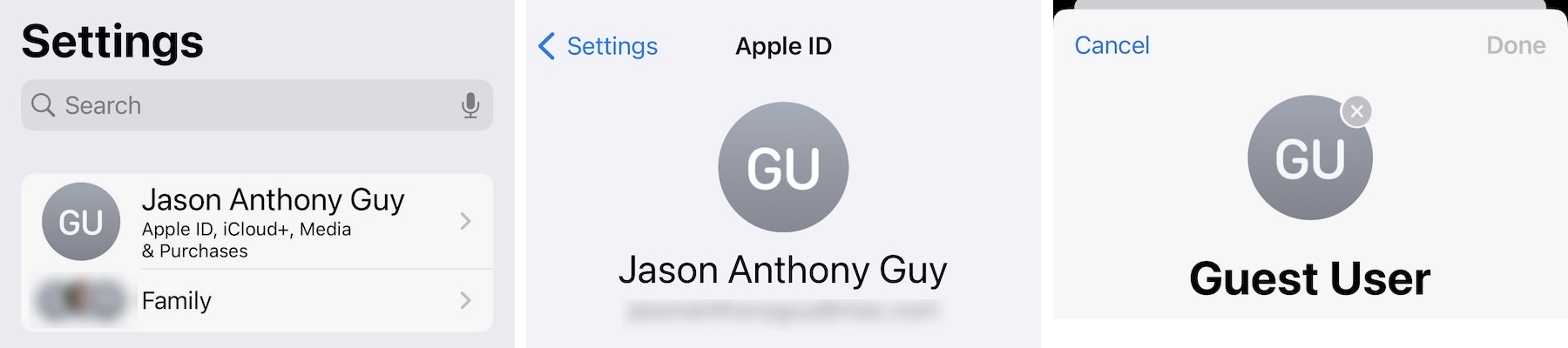
On iOS (or iPadOS) in Settings (assuming you’re signed into your iCloud account), you should see Your Name at the top of the screen, along with either your initials in a circle or an image you’ve selected.
Instead, it was “GU”, with the initials-in-a-circle default, but not my initials of “JG”. I tapped my name, and then the GU initials, and the name shown was “Guest User.”
Interesting… iOS doesn’t have a “guest user” mode. And it was happening on two devices signed into the same iCloud account.
Hm.
I struggled to find an answer, so I threw it out to Mastodon, and then in typical fashion, I answered my own question a short while after.
(If the best way to get a right answer is to give a wrong answer, the best way to answer your own question is to ask it.)
I knew the name was taken from the Contacts app, specifically the My Card setting. Sure enough, the Contacts app showed My Card was “Guest User”: first name Guest, last name User, with an otherwise empty Contacts entry. I have no idea how or why that contact card was created, nor why it was selected.

On macOS, I would select the contact I wanted to be My Card, then select Card > Make This My Card from the menu.
I couldn’t find a way to do this in the Contacts app on iOS.
That’s because it’s not in the Contacts app. It’s in Settings, under Contacts > My Info, from where you can then choose your contact card. Of course! iOS apps rarely have preferences within them; they’re usually in the Settings app.
(You can also change this in Settings under Siri & Search > My Information. I don’t know why it’s in two places, other than Siri uses this information.)
The Fix (in summary)
If your iCloud account name in Settings is unexpectedly wrong, here’s how you fix it:
- On iOS (or iPadOS), open Contacts and confirm My Card has the wrong name.
- Optional: If the contact is otherwise empty, delete it: Tap the name, tap Edit, tap Delete (at the bottom).
- Open Settings, scroll to and tap Contacts > My Info. (Alternatively: Siri & Search > My Information.)
- Select the correct contact. Create a new one if necessary.
So there you have it, a minor mystery solved.
Remastered 3D Coraline Returning to Theaters in August, Tickets Insta-Bought⚙︎
Coraline is one of my favorite movies, with an evocative score, sublime stop motion animation, and beautiful visuals (especially in 3D). Hard to fathom it's been 15 years. A remastered 3D version in theaters? Insta-buy. It'll be an early birthday gift to myself.
Between this and Batman: Caped Crusader, August is looking to be a great month.
Coraline | Official Website | 15 August 2024
Get tickets for Coraline 15th Anniversary. In cinemas worldwide from August 15.
 Powster
Fantastic Trailer For New Batman: Caped Crusader Series⚙︎
Moody visuals, classic animation style, and a stellar voice cast. From Bruce Timm (creator of the multi-Emmy Award-winning Batman: The Animated Series), J.J. Abrams, and Matt Reeves. Set, seemingly, in an alt-’40s, with a familiar rogues' gallery: Catwoman, Harvey Dent/Two-Face, Harley Quinn, Penguin, and more. On Prime Video, of all places.
Coming August 1. I'm in.
Hed Writer At The Verge Understood The Assignment⚙︎
Exquisite headline for The Verge’s story on Microsoft’s new Arm-based laptops. I won't spoil it, just click the link and enjoy.
Anil Dash: “A board of directors is a structure that is about power in an organization”⚙︎
Anil Dash (at an absolute gem of a URL):
I realize that most people who've never been in the boardroom have a lot of questions (and often, anxieties) about what happens on a board, so I wanted to share a very subjective view of what I've seen and learned over the years.
I definitely have both (questions and anxieties).
He goes into great detail, based on his many years of serving on boards, both for his own companies and for other organizations. He describes the job of a board, what board meetings look like, how they’re organized and function, and the day-to-day experience of being a board member.
Too few people are willing to share their experience of actually being in the room. What is it really like to be, for example, a software developer, an engineering manager, or, I dunno, a flautist? Having an “insider view” can help demystify a role, making it seem less unobtainable (or, perhaps, less idyllic).
The section most relevant to me, then, was How do you get in the room?
The first thing to know is, your initial impressions and suspicions are correct: it’s not fair, and it’s not nearly inclusive.
No surprise there, and one of several reasons motivating me to join a board.
The for-profit organizations were overwhelmingly comprised of very wealthy white men, with a small smattering of Asian American men, though the non-profits were notably better in nearly every dimension of inclusion.
A reality we can see across many Fortune 500 companies.
More pervasive, though, is the old-boys’ network.
Oh dear. My goal: To bring the benefits of the old-boys’ network to more than just the old boys.
From talking to those who’ve served on more traditional boards, there’s an almost uniform, reflexive dismissal of the idea, where legacy board members will assert that any class of people who haven’t been in the board room before must certainly have been excluded on the basis of merit, as everyone in the room got there purely on their own skills and talents. It’s bullshit, but I’ve heard it so consistently, in almost the same stupid “we can’t lower the bar” phrasing, that it must be the common belief of the majority of people serving on boards today.
Disheartening, but unsurprising. Meritocracy is a pervasive (and wrong) belief of the already successful.
And I expect that a lot of people who agree with the desire to make things more inclusive probably also feel the pressure of being the “only one” in the room, so they don’t want to be seen as arguing for inclusion, lest they get treated as the token diversity hire on the board and have their other ideas dismissed.
As “the ‘only one’ in the room” for most of my career, he’s spot on about this tension.
I’m deeply thankful to Anil for these insights. They offered valuable clarity for what I should expect from being on a board. Joining a board of directors is one of my post-retirement goals. I see it as a way to contribute my experience and energy to an organization doing work I care about. Forming a board will be necessary as I get closer to launching a nonprofit organization.
I’ll be revisiting this article many times in the next months.
Update: There's now an extensive Q&A, sourced from his readers.
Nvidia, Now Valued at $3T, Was Saved By Sega In 1995⚙︎
Damien McFerran at TimeExtension.com shares the story of Nvidia’s near-bankruptcy in 1995, after partnering with Sega to build a game console:
If we had finished that game console with Sega and fulfilled our contract, we would have spent two years working on the wrong architecture while everybody else is racing ahead in this new world that, quite frankly, we kind of started.
On the other hand, if we didn’t finish the contract, then we run out of money. And so I was confronted with a situation where we would finish the project and die, or not finish the project and die right away.
Sega released them from their contract, and also paid them the $5 million that would have been due.
It was all the money that we had. And it gave us just enough money to hunker down.
Nvidia is now worth over $3 Trillion, briefly surpassing Apple and Microsoft.
What a remarkable comeback.
I also enjoyed this recent Joy of Tech comic spotlighting Nvidia’s recent massive growth.
nVidia then and now!
Hard not to be envious!


(Via @Sonikku.)
Is AI a Product or a Feature?
Marques Brownlee (MKBHD) tackles the eternal product marketing question of “Product or Feature” when it comes to AI.
He highlights the Humane Ai Pin and Rabbit R1 as examples of “AI as a product,” that is, a standalone thing you buy that “does AI,” versus being integrated into existing products, such as a phone or smart home device.
Both the Humane Pin and Rabbit R1 require AI for them to be useful. Without AI, they are merely interesting hardware products that provide no meaningful functionality. Everything they do with AI can easily be (and perhaps already is being) done on a phone, either via an app or integrated into the system. The unique hardware bits they have exist solely because they’re not phones and need some mechanism for us to interact with them. A phone without AI is still useful. A Humane Pin without AI is… what? An attractive accessory?

AI is an enabling technology. People aren’t buying AI. They’re buying what AI can do for them. The question for any company selling an “AI product” is “to do what?”
If the what can be incorporated into another, more popular or widely used product, that “AI product” is in danger of being obsoleted, or at least becoming less relevant.
Marques uses the once-popular Clubhouse to highlight this transition. The enabling technology for Clubhouse was “live voice chatrooms”. However, the product was effectively obsoleted after other companies incorporated this feature into their own, more popular apps. People didn’t want Clubhouse, per se. They just wanted to chat with each other.
It’s likely we’ll see this happen a lot more for “AI products.” As Marques points out, Apple’s WWDC Keynote showcased many features powered by AI. In almost every instance, products that do “that thing” already exist today. Such products may soon become superfluous to a large number of Apple’s customers, because customers care about the feature, not the product.
One example: The next versions of iOS and macOS bring the ability to “rewrite, proofread, and summarize text,” directly integrated into just about every text field on the systems. This is huge for Apple customers. But if you’re, say, Grammarly, for whom “AI writing partner” is what you sell, you’re now competing with Apple in your only business. Feature, not product.

This isn’t to say Grammarly goes away. They provide some features not offered in Apple’s version, and as they noted to NPR:
Whenever new entrants come into our market, the reality is that we see increased demand for Grammarly.
OK, sure. But how many people will pay $12/month when they can get a basic “AI writing partner” for free?
As Apple demonstrated, it’s possible to build your own AI stack, and subsume AI-powered features, making them “just another bullet point” on a deck or press release.
Look at ChatGPT, for instance. Despite being the best-known, most popular AI chatbot, it was the last item mentioned in Apple’s two-thousand-word Apple Intelligence press release. And it won’t even be the only chatbot available on Apple’s devices. Eventually you’ll be able to replace ChatGPT with Anthropic’s Claude, Google Gemini, Microsoft Copilot, and who knows what else. Feature, not product.
And dollars to doughnuts, Apple already plans to Sherlock all of these chatbots, as they do with so many other features-pretending-to-be-products.
So is AI a Product or a Feature? Marques demurs:
Now there is no answer yet as far as is AI actually a feature or a product, which one will win, which one will lose, we don't know. But I think if history is any indication, I do think that more people in the long run are going to end up using this AI stuff as a feature, more than going to, like, a standalone thing.
I agree that for most people AI will simply be the technology that powers features they love. They won’t go seeking out AI, and won’t buy standalone “AI products”. In fact, most won’t think about AI at all.
The trajectory technology takes is to transition from a visionary product to an important feature of another product to a mundane feature used without thinking.

A great example comes from my friend Ron Lue-Sang: Biometric authentication.
In popular media, fingerprints, facial recognition, and retina scans once demonstrated just how advanced the civilization (or organization) was. Visionary.
Then biometrics were added to products like door locks as a key reason to buy them. Important.
Today we unthinkingly unlock our phones and computers with our fingers and faces. Mundane.
Companies will continue to sell “AI products” for as long as they can, and many of them will exist as foundational technologies and find ways to differentiate themselves, but most are on a glide path toward irrelevance. For me, and I think for most people, AI is absolutely a feature, not a product, and one we won’t even think of as AI.
So perhaps the question isn’t “is AI a product or a feature?”
Perhaps it’s “when will AI become mundane?”
⚙︎Stanford University’s Discovering Sherlock Holmes
I love a good mystery. As a little boy, I read Encyclopedia Brown, the Hardy Boys/Nancy Drew series, all of Agatha Christie’s works, and Sherlock Holmes. Solving mysteries probably goes a long way to explaining why I love computers.
I recently stumbled across a couple of very old books, gifts from my parents in 1985: Alfred Hitchcock’s Daring Detectives, a collection of eleven “Exciting Stories of Great Feats of Detection” featuring Ellery Queen, Dame Agatha’s Hercule Poirot, Perry Mason, and more; and an anthology of five of Agatha Christie’s Miss Marple novels.
You may be able to tell I read the snot out of these.


I also found 12 issues of Stanford University’s facsimiles of The Strand Magazine featuring Sir Arthur Conan Doyle’s “consulting detective.”
The Strand Magazine was a monthly publication which was, among other things, the first to publish the Sherlock Holmes stories. It also serialized The Hound of the Baskervilles in 1901. Readers, according to Wikipedia,
lined up outside the magazine’s offices, waiting to get the next installment.
Back in 2006/2007, as part of Stanford’s exploration of the Victorian era, they published these facsimiles and sent them monthly—for free—to anyone who requested them. I couldn’t resist.
They published 24 issues, but I foolishly only signed up for the first half. Fortunately, that half included The Hound of the Baskervilles, serialized and made available monthly just as they were to readers in 1901. I loved waiting for, and then devouring each issue.

They’ve long since discontinued publication, but they’ve kept the website up. You can download all the individual issues as PDFs, though it’s not obvious how to get to all of them, so as a public service, below are the direct download links for each issue.
If you’d like to save yourself two dozen clicks, I’ve compiled them all into a single zip file you can download. I also renamed the PDF files for consistency.
Series 1, 2006
| Issue 1: A Scandal in Bohemia |
| Issue 2: The Speckled Band |
| Issue 3: The Hound of the Baskervilles (1/9) |
| Issue 4: The Hound of the Baskervilles (2/9) |
| Issue 5: The Hound of the Baskervilles (3/9) |
| Issue 6: The Hound of the Baskervilles (4/9) |
| Issue 7: The Hound of the Baskervilles (5/9) |
| Issue 8: The Hound of the Baskervilles (6/9) |
| Issue 9: The Hound of the Baskervilles (7/9) |
| Issue10: The Hound of the Baskervilles (8/9) |
| Issue11: The Hound of the Baskervilles (9/9) |
| Issue12: The Final Problem |
Series 2, 2007
| Issue 1: The Empty House |
| Issue 2: Silver Blaze |
| Issue 3: Musgrave Ritual |
| Issue 4: Reigate Squires |
| Issue 5: The Greek Interpreter |
| Issue 6: Charles Augustus Milverton |
| Issue 7: The Abbey Grange |
| Issue 8: The Second Stain |
| Issue 9: The Bruce Partington Plans |
| Issue10: The Devil’s Foot |
| Issue11: The Dying Detective |
| Issue12: His Last Bow |
Try reading them one per month for the full experience!
⚙︎“Cricket was America’s first modern team sport”⚙︎
In my recent linked post about the US team’s loss to England, I wrote:
I’m hoping this is the start of America’s love affair with cricket.
Rishabh Sharma, writing for India Today:
For the unversed, this may sound unbelievable. [...] But the gentleman's game has a long history in the US. Long before baseball claimed the American sports landscape, cricket was a prominent and popular game, embraced by a diverse array of players across the young nation.
Of course cricket was once popular in America, it was a British colony. It was shortsighted of me not to consider that.
For the British colonists who settled in North America, cricket was a pastime. By the mid-1700s, cricket had spread to other territories, with matches being reported in Virginia and Pennsylvania.
After 1783, when the American Revolution ended, the interest in all things British waned in America. But cricket continued to thrive and by the mid-1800s, the sport was being played in 22 states.
At one point, cricket was more popular than baseball, and The Philadelphia Cricket Club, established in 1854, is still around today.
Why did cricket lose out to baseball? As you might suspect:
The Civil War also saw a cultural shift in American sports as baseball began to be seen as a more American sport compared to cricket, which had a strong British association. The post-war period was a time of growing American nationalism, and baseball fit well into this cultural shift.
But, cricket is having a resurgence today, driven, ironically, by immigrants from former British colonies where cricket remained popular. There’s now a six-team Major League Cricket league, and the USA Cricket organization.
I guess what I should have said was I’m hoping this is a restart of America’s love affair with cricket.
U.S. Cricket Team out of T20 After Defeat by England⚙︎
Ben Burrows, writing for The Athletic:
The United States is out of the T20 Cricket World Cup after a heavy defeat by England in Bridgetown, Barbados.
A colonizer defeating one former colony on the grounds of another former colony. That’s cricket for you.
The U.S. was a revelation in its first global competition and by reaching the Super Eights — a second group phase — will automatically be part of the next T20 World Cup, which will be held in India and Sri Lanka in 2026.
It’s hard to be too disappointed by the loss, though, considering it’s the team’s first match on the world stage, they upset Pakistan, and will play in the next T20 World Cup.
I’m hoping this is the start of America’s love affair with cricket.
U.S. captain Aaron Jones:
“The wicket was a bit sticky and Adil Rashid is for sure a very good bowler. I didn’t think our shot selection was the best. We knew he was the dangerman on this wicket for sure, and we still gave him some wickets as well.”
Translation for baseball fans: The ball was darting around the plate, and the pitcher was on his game. We were swinging at balls way out of the strike zone. We knew he was the ace on their staff, and we still gave him some easy outs.
Reggie! bars, a candy blast from the past⚙︎
If you watched the aforelinked conversation with Reggie Jackson, you may have noticed the orange box sitting on the desk. These are Reggie! bars—chocolate, peanuts, caramel—and named after the man himself. I ate them as a kid growing up in New York. They were delicious.
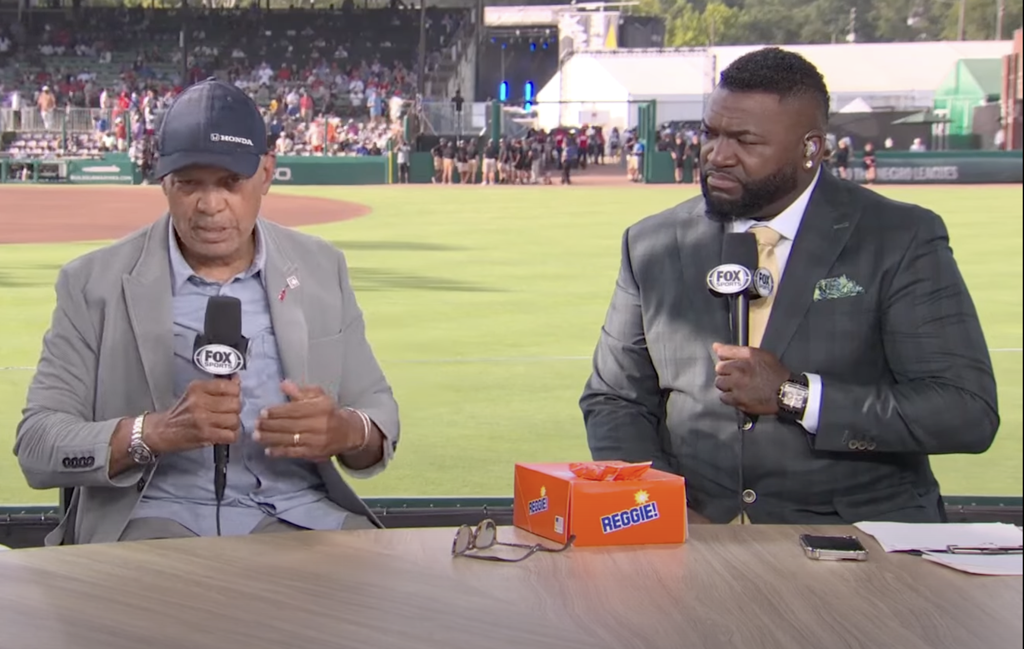
The story behind them is when Jackson was with Baltimore Orioles in 1976 and hoping to get traded, he boasted in an interview,
If I played in New York, they’d name a candy bar after me.
Jackson signed with the New York Yankees in 1977, and after a stellar post season (where Jackson earned his nickname "Mr. October"), The Curtiss Candy Company rebranded an existing candy—the Bun Bar—to Reggie!, and Jackson’s boast came true.
They were discontinued in 1981, then revived briefly in the early 1990s. As of 2023 they're again available. You can buy a case (autographed, if you’d like) directly from Reggie Jackson’s website (or on Amazon), but at $70, it’s too much for me to indulge my nostalgia.
Case of Reggie Bars | Reggie Jackson
Experience the excitement of Opening Day 1978 at Yankee Stadium all over again with the return of the iconic Reggie Bars! Throwback to the iconic moment when Yankee fans tossed Reggie Bars onto the field in joy after Reggie Jackson hit a homerun. Hall of Famer Reggie Jackson has teamed up with American Candy Nostalgia to bring back the beloved Reggie Bar. Indulge in the delicious combination of chocolate, peanuts, and a caramel center with the re-launch of the Reggie Bar. Contains Milk, Peanuts, Soy - See description for more specific ingredients. Manufactured in a facility that also processes: Egg, Wheat, Almond, Cashew, Pecan, Coconut.

Reggie Jackson Tells The Truth About Racism⚙︎
Reggie Jackson, asked during a tribute to Negro League Baseball about returning to Rickwood Field in Alabama, where he played Double-A baseball:
Coming back here is not easy. The racism when I played here, the difficulty of going through different places where we traveled.… I wouldn't wish it on anybody…. I would never want to do it again. I walked into restaurants and they would point at me and say “the n— can’t eat here”. I would go to a hotel and they said “the n— can't stay here.” We went to Charlie Finley’s country club for a welcome home dinner and they pointed me out with the N word. “He can't come in here.” Finley marched the whole team out.… He said we're going to go to the diner and eat hamburgers, we’ll go where we're wanted. Fortunately, I had a manager in Johnny McNamara that if I couldn't eat in the place, nobody would eat, we’d get food to travel. If I couldn't stay in a hotel, they’d drive to the next hotel and find a place where I could stay.
This is not the answer Fox Sports expected, but was definitely the one that was needed. A reminder that he’s talking about 1967. It’s not that long ago, practically within my lifetime.
Also, great examples on how to be an ally. You stand together. Either everyone is in, or no one’s in.
Be sure to scroll back to the beginning to hear Reggie call Willie Mays “a Baryshnikov on the baseball field.”
A New Beginning
As an Apple nerd, the week of WWDC is both a great and a terrible time to launch something new. Almost no one will pay attention to this new website, yet it gives me much to write about.
If you’re also an Apple nerd (and if you’re reading this, there’s an above-average chance you are), Apple’s annual Worldwide Developer Conference offers a ton to explore, learn, and generally obsess over. For many, it sets the direction for the rest of their year, acting as something of a launching pad, a new beginning.
For over two decades, WWDC was a major focal point of my year. I worked in Apple’s Worldwide Developer Relations organization (WWDR), which puts on the show, and the team I was on, Developer Technical Support (DTS), was an integral part of it.
Months of long days, sleepless nights, and endless planning meetings culminated with WWDC Monday. It was immensely gratifying to see the results of many months of hard work from the teams make it to the stage or screen. And while much of what was announced at any given show was a surprise to me, my excitement was generally tempered by having already spent a lot of time living on the new software.
Not so this year. It’s my first WWDC “on the outside” since 2001[1], and my anticipation for what’s new was sky-high.
Restraint
That amped-up level of anticipation was shared by many this year. Leading up to WWDC, there was much speculation about what Apple would do with AI, and its impact on the company’s fortunes.
Apple answered those questions, but they sure took their time.
Monday’s Keynote was effectively two events. The first sixty minutes was the normal annual updates of Apple’s software product roadmap: All the new features coming in iOS 18, iPadOS 18, tvOS 18, watchOS 11, macOS Sequoia, and visionOS 2, with a surprisingly long Apple TV+ segment at the top. Despite the hype and anticipation, there wasn’t a single mention of “AI” or “artificial intelligence” in this first hour.
I must applaud Apple’s restraint here. I speculated last week,
What if Apple announces “Siri AI” and says it’s “Advanced Interactions” or “Apple Intelligence”?
“Edit your photos using your voice. Powered by Siri AI….”
“Xcode 16 helps you write code twice as fast using Siri AI.…”
“In the newly improved Developers Forums, you can quickly find answers to your code-level questions thanks to Siri AI….”
They get to utter “AI” a bunch of times, but make it distinct from “artificial intelligence”.
It would be very Apple to try to redefine what AI means.
🤔
What I expected was a presentation littered with “AI” droppings to satisfy those carping about Apple falling behind in AI. Instead, Apple stuck to their usual language as they highlighted new features enabled by “intelligent capabilities”, “machine learning”, and “powerful new algorithms”, just as they have for years.
It was in the back forty minutes that we finally got what for many people was the main attraction: The introduction of “Apple Intelligence”, Apple’s marketing name for their on-device, privacy-focused, deeply integrated take on artificial intelligence.
(Aside: I’m hardly the first person to come up with “Apple Intelligence” as a likely marketing name. After all, Apple has been known to use the occasional pun or two in their brand marketing. I would have been disappointed if they hadn’t used it. End aside.)
Apple Intelligence
Tim Cook introduced the section on Apple Intelligence this way:
At Apple, it’s always been our goal to design powerful personal products that enrich people’s lives, by enabling them to do the things that matter most, as simply and easily as possible.
We’ve been using artificial intelligence and machine learning for years to help us further that goal. Recent developments in generative intelligence and large language models offer powerful capabilities that provide the opportunity to take the experience of using Apple products to new heights.
So as we look to build in these incredible new capabilities, we want to ensure that the outcome reflects the principles at the core of our products. It has to be powerful enough to help with the things that matter most to you. It has to be intuitive and easy to use. It has to be deeply integrated into your product experiences. Most importantly, it has to understand you, and be grounded in your personal context, like your routine, your relationships, your communications and more. And of course, it has to be built with privacy from the ground up. Together, all of this goes beyond artificial intelligence. It’s personal intelligence, and it’s the next big step for Apple.
I included the entire quote[2] because I see this as Apple’s AI thesis. Their privacy-first approach to AI is all about experiences and functionality, not data collection. Technology as Infrastructure, not as a business model. Apple Intelligence gives Apple (and developers) the ability to craft experiences that are relevant to you, using the extraordinarily personal information available on your device, and without compromising your privacy.
This is the right approach. People care more about what technology lets them do—or can do for them—not the technology itself. They buy a new iPhone because it “takes better photos” not because it has an “ƒ/1.78 aperture.” The technology enables the feature, but it’s not the feature.
For Apple, it’s not about AI, it’s about what AI enables.
What sets Apple Intelligence apart from other offerings are Siri’s deep integration with the system, on-device processing, and new cloud server infrastructure.
With Siri’s improved integrations, better natural language understanding, and awareness of my personal contexts, my iPhone, iPad, and Mac—which already know more about me than my wife or mom—will be able to use that knowledge even more directly.
It’ll do this without needing to go to the cloud. Large parts of Apple Intelligence will be processed locally, which is a massive win for both speed and privacy. (This requires a device with the latest Apple silicon: iPhone 15 Pro, or any M-family iPad or Mac. I presume any new iPhones announced this year will qualify.)
For requests too complex to process locally, Apple’s new cloud server infrastructure comes into play. Dubbed Private Cloud Compute, it uses Apple silicon-powered servers created specifically for this task. The data sent to those servers is limited, it only uses the data for your requests (not to train models for others), and then deletes the data once the task is completed.
Craig Federighi noted:
You should not have to hand over all the details of your life to be warehoused and analyzed in someone’s AI cloud.
This is what differentiates Apple from everyone else doing AI, and why Apple remains one of the few companies I trust with vast amounts of my personal data. Apple Intelligence is built, as Tim noted, “in a uniquely Apple way.” They aren’t trying to make money off your data, so there’s no need to hold onto it. It’s a solution “only Apple” could make, because only Apple doesn’t want your data for any reason other than to fulfill your requests.
Siri
The Apple Intelligence section was filled with demos showcasing its capabilities. Many were tied to generative writing and images, done locally, and constrained to specific contexts. I found them interesting but not exciting.
Three examples did make me shiver with anticipation. All were tied to Siri’s deeper integration into and across the system:
- You’re filling out a form and it requires your driver’s license. If you have a copy of your license in Photos, Siri will be able to find that photo, copy your license number, and type it into the form for you. I had this exact need just a few days ago. I had to launch Photos, search for “driver’s license”, tap on the text icon, and copy and paste the number. It was quite handy, as I didn’t have to leave the couch to grab my wallet, but I can’t wait until I can say “Siri, paste in my driver’s license number.”
- A friend sends you a Message with his new address. You say to Siri “add this address to his contact card”. Siri knows what’s on your screen, what an address is, how to get and format an address, what “this” address refers to, what a “contact card” is, who “his” means, what it means to “add to contact card”, and how to add it to the Contacts app.
- You’re picking your mom up from the airport. You ask Siri “what time is my mom’s flight landing?” Siri knows who “my mom” is, what flight she’s on (because of an email she sent earlier), and when it will land (because it can access real-time flight tracking). You follow up with “what’s our lunch plan?” Siri knows “our” means you and your mom, when “lunch” is, that it was discussed in a Message thread, and that’s it today. Finally, you ask “how long will it take us to get there from the airport?”. Siri knows who ”us” is, where “there” is, which airport is being referenced, where you are now, and real-time traffic conditions.
I’ve been dreaming about this type of game-changing interaction since first seeing Apple’s Knowledge Navigator concept video, where—among other futuristic things—an “intelligent agent” has such deep contextual knowledge about you, it jumps in when you hesitate with the answer to a forgotten appointment time.
History
The WWDC video opens with Phil Schiller flying an airplane filled with Apple executives[3]. Craig is pumping them up ahead of the show, then they all parachute out above Apple Park. The airplane, the jumpsuits, and the parachutes themselves are all liveried in the six colors of the classic Apple logo. It’s a lovely callback to Apple’s history.

Ninety minutes later, toward the end of the event, Craig introduces the tag line for Apple Intelligence: AI for the rest of us.
This is another callback to the earliest ads for Macintosh, the computer for the rest of us, and I think it encapsulates everything about how Apple may envision their place within the broader AI ecosystem.
The original series of ads compared the graphical user interface and one-button mouse of Macintosh to DOS-based PCs where you typed in cryptic text-based commands to get things done. In one ad, a Macintosh is removed from a zippered bag:
It’s more sophisticated, yet less complicated.
It’s more powerful, yet less cumbersome.
It can store vast amounts of yesterday, or tell you what’s in store for tomorrow.
It can draw pictures, or it can draw conclusions.
It’s a personal computer from Apple, and it’s as easy to use as this.
The ad ends with a finger pressing a mouse button, highlighting the simplicity of using a Macintosh.
With new visuals, and some minor changes to the narration, this could be an ad for Apple Intelligence.
It can’t be coincidence that a Keynote that opens by evoking the early days of computing, ends with one too. Apple is saying there’s Artificial Intelligence, which is all about LLMs and models and prompt engineering, which requires specialized knowledge and lots of typing to create something, and there’s Apple Intelligence, which uses context and relevance and personal knowledge to make it easy to get things done.
The pundits say Apple has fallen behind.
Apple is telling us this is just the start.
In October, 2023 I retired from Apple after 22 years. Being on the outside means I can, for the first time in two decades, write about Apple. So, here we are. ↩︎
Beth Dakin, Craig Federighi, Cyrus Irani, Dr. Sumbul Desai, Kelsey Peterson, Mike Rockwell, Phil Schiller, Ron Huang, Ronak Shah, and Susan Prescott. Also: Nine people jumped, but only eight parachutes were shown to open. ↩︎
Retired
After 22 (and a half!) years at Apple, I’ll be going on an extended, open-ended sabbatical.
That is, I’m retiring.
I’ve spent my entire career at Apple in Developer Technical Support (DTS), part of Worldwide Developer Relations (WWDR). In my time, I’ve been fortunate enough to be a (small) part of every OS launch, hardware transition, and WWDC since April of 2001.
I’ve helped developers move from Carbon to Cocoa, Objective-C to Swift, PowerPC to Intel to Apple silicon, a “sweet solution” to native development. I’ve helped them ready apps for the introduction of iPhone, iPad, Apple TV, Apple Watch, and now Vision Pro.
I worked closely with App Review from its initial launch, and helped launch and lead the Mac App Review team.
I partnered with Inclusion and Diversity and University Recruiting to help bring focus to the hiring, retention, and growth of female and Black engineers across Apple, and I was honored to be on the leadership team for Women@Apple-Tech for two years, and Co-chair of Black@Apple (formerly African-American Employee Association) for seven years.
All of which is to say:
I’ve had the great good fortune to work with hundreds of the smartest people across Apple in pursuit of things that mattered.
Whether it was addressing an issue affecting thousands of developers; crafting and polishing a talk for WWDC, Grace Hopper or NSBE; or exploring race and gender in the industry, every day I was part of remarkable, thought-provoking, insightful discussions with people from across this amazing company.
Those discussions have educated me, challenged me, comforted me.
Steve said “the journey is the reward”. To all of my colleagues past and present, thank you for being a part of my journey, for making it rewarding beyond measure.
What's next?
For the first couple of months, I plan to relax and recharge, to “drain my brain”. After that, I’ll be reconnecting to some long-dormant hobbies, including photography, podcasting, and perhaps some writing.
Sometime next year I plan to launch an organization for the next generation of tech leaders of color. The focus will be on building important non-tech skills, facilitating conversations that go beyond pure engineering and technical discussions, and strengthening networks and community. I’m excited to use my experience and skills in different ways, to be a mentor and coach, to open doors, and show a path upward.
⚙︎CNET’s Interview with Chadwick Boseman
I linked to this CNET article in my previous post about Chadwick Boseman’s death to highlight his influence on the authenticity of Black Panther, but it deserves its own post.
It’s a great interview that really demonstrates how thoughtful he was, and I specifically wanted to highlight this bit:
Boseman: People think about how race has affected the world. It's not just in the States. Colonialism is the cousin of slavery. Colonialism in Africa would have it that, in order to be a ruler, his education comes from Europe. I wanted to be completely sure that we didn't convey that idea because that would be counter to everything that Wakanda is about. It's supposed to be the most technologically advanced nation on the planet. If it's supposed to not have been conquered -- which means that advancement has happened without colonialism tainting it, poisoning the well of it, without stopping it or disrupting it -- then there's no way he would speak with a European accent.
If I did that, I would be conveying a white supremacist idea of what being educated is and what being royal or presidential is. Because it's not just about him running around fighting. He's the ruler of a nation. And if he's the ruler of a nation, he has to speak to his people. He has to galvanize his people. And there's no way I could speak to my people, who have never been conquered by Europeans, with a European voice.
Just brilliant.
⚙︎Chadwick Boseman Dies of Colon Cancer
Chadwick Boseman died of colon cancer yesterday, after being diagnosed—and working—with it in 2016. This makes me incredibly sad. He seemed like a genuinely nice guy, who also happened to be supremely talented.
Black Panther was an epic moment in Black culture. At the time, it felt like literally every Black person in the world was anticipating this movie, and he brought King T'Challa to life with grace and humility.
This movie was a profound revelation. It filled theaters with people from all walks of life, of every creed and race, and for two hours, immersed them in an unbounded, unapologetic celebration of Black excellence.
Chadwick’s portrayal (and, from what I’ve read, his insistence on authenticity, with accents and more) was a huge part of what gave this move its heart.
Thank you Chadwick for your talent and your humanity.
You are with the ancestors now.
#WakandaForever
— Chadwick Boseman (@chadwickboseman) August 29, 2020
“Black Panther” Is Inspiring Black Brazilians to Occupy Elite, White Shopping Malls
It makes me want to win. It makes me want to fight. It makes me like myself more, like my own skin tone, like my kind of hair, like the shape of my nose, like the shape of my lips, like myself more. Because you start to see people who are like you and you see how they carry themselves — empowered, happy with themselves — and you start to like yourself better. And you see there’s nothing wrong with you — that, really, black is beautiful, black is capable, black is incredible, and blackness needs to be respected.
A movie, about fictional superheroes. This is what representation can do.
(I’ve seen the movie twice, plan on seeing it again, and will be preordering the Blu-Ray. It’s a very good movie.)
⚙︎Why I Quit Google to Work for Myself
Michael Lynch came to a realization:
It may sound strange that it took me two and a half years to realize it, but Google does a good job of building a sense of community within the organization. To make us feel that we’re not just employees, but that we are Google.
That conversation made me realize that I’m not Google. I provide a service to Google in exchange for money.
This is a realization everyone in corporate America comes to, eventually. I came to mine about a quarter century ago, after getting unexpectedly fired from a job I loved, for reasons that were lies.
I’ve been at my current job just a couple years shy of two decades. I have no illusions about our relationship, though I have managed to build up some significant loyalty to them. They, like Google, work very hard to make you feel like you are the company.
It might be time to revisit, or exploit, that loyalty....
Oh yeah, and the review and promotion process at Google sucks. But at least it’s documented.
⚙︎How to Buy a Gun in 15 Countries
Yemen has the second highest gun ownership rate, behind the United States. To buy a gun in Yemen, you
1 Go to a gun market or find a seller online. 2 Buy a gun.
The process for the U.S. is ever so slightly stricter:
1 Pass an instant background check that includes criminal convictions, domestic violence and immigration status. 2 Buy a gun.
This is where I note that Yemen is the poorest country in the Middle East, and recently went through a coup d'état.
The process for buying guns is much different in countries such as Japan, Australia, and Canada, where mass shootings are practically non-existent.
We need to fix our country’s obsession with guns.
⚙︎Why Are There Few Women in Tech? Watch a Recruiting Session
Jessi Hempel in Wired, on a study of introductory sessions held by tech companies at a university (likely Stanford):
The chilling effect, according to Wynn, starts with the people companies send to staff recruiting sessions. As students entered, women were often setting up refreshments or raffles and doling out the swag in the back; the presenters were often men, and they rarely introduced the recruiters. If the company sent a female engineer, according to the paper, she often had no speaking role; alternatively, her role was to speak about the company’s culture, while her male peer tackled the tech challenges. Of the sessions Wynn’s research team observed, only 22 percent featured female engineers talking about technical work. When those women did speak, according to the sessions observed, male presenters tended to interrupt them.
The study may have focused on women, but I assure you other poorly represented groups notice similar things about their demographic.
Also:
The paper also describes recruiters using gender stereotypes. One online gaming company showed a slide of a woman wearing a red, skin-tight dress and holding a burning poker card to represent its product. Another company, which makes software to help construct computer graphics, only showed pictures of men—astronauts, computer technicians, soldiers. Presentations were often replete with pop-culture images intended to help them relate to students, but that furthered gender stereotypes. One internet startup, for example, showed an image of Gangnam style music videos that featured a male artist surrounded by scantily clad women.
How clueless does your recruiting team need to be to not flag and fix this?
⚙︎Keith Olbermann ends #TheResistanceGQ
@KeithOlbermann:
NEW VIDEO: The last episode of #TheResistanceGQ. The good news: I’m finishing it because I think - especially after “Pocahontas” - Trump is unavoidably, inevitably, and in every possible path open to him, FINISHED
I wish I could honestly say I agreed with him. I’m truly sad he won’t be doing any more of these commentaries1. I very much enjoyed them, so much that I bought Trump Is F*cking Crazy, his book based on these commentaries.
Still, until it happens: “Resist. Remove. Peace.”
- Unless he’s right. 🤞 ↩
Project Veritas fails an attempted undercover sting against The Washington Post
A woman who falsely claimed to The Washington Post that Roy Moore, the Republican U.S. Senate candidate in Alabama, impregnated her as a teenager appears to work with an organization that uses deceptive tactics to secretly record conversations in an effort to embarrass its targets.
A remarkable story of careful investigative reporting on the part of The Washington Post. In the videos, one of the reporters, Stephanie McCrummen, seems both tenacious in her questions and genuinely concerned for the woman making the false accusations.
Even more remarkable is that Project Veritas is defending Roy Moore’s behavior by trying to discredit his actual accusers with fake ones.
⚙︎The Culture Caught Up With Spike Lee — Now What?
Wonderful profile of a filmmaker who’s had an undeniable impact on filmmaking and culture, by Thomas Chatterton Williams in The New York Times.
In 31 years, Lee has achieved a rate of productivity that is rivaled in America only by Woody Allen. His body of work is prodigious: 22 feature movies, of which at least three are absolutely first-rate; a half-dozen more are flawed classics, and all of them are at least sporadically brilliant, artistically daring and always intellectually ambitious. There are also many documentaries, which cover a wide range of black American topics, including two on Michael Jackson and one on Kobe Bryant. Of these, “4 Little Girls” (1997), about the Birmingham church bombing, and “When the Levees Broke” (2006), about Hurricane Katrina, are two of the best documentaries ever made about black life — or perhaps just life — in the South.
I assume “Do the Right Thing” is one of the three that “are absolutely first-rate”. It’s one of the great movies in cinema history, and remains surprisingly relevant and topical, nearly 30 years later. Williams writes:
I told him that I recently rewatched “Do the Right Thing” and was astounded by the degree to which it felt au courant and even prescient. The scene late in the film when an N.Y.P.D. officer places Radio Raheem in an illegal chokehold, killing him, was shattering to watch, melding in my mind with phone-camera footage of Eric Garner, who was killed in 2014 on Staten Island in similar fashion. And the question at the heart of the drama — just whose vision of black life can (or should) prevail, anyway, Malcolm’s or Martin’s — was trenchant. Lee’s own views on that question remain satisfyingly ambiguous. While the film seems to imply that it is Malcolm who personifies genuine integrity, Lee has also observed that Radio Raheem could have behaved differently and avoided his violent fate.
The movie also brought us Samuel L. Jackson, Rosie Perez, Giancarlo Esposito, and Martin Lawrence.
I’ll be watching the Netflix reboot of “She’s Gotta Have It”. It’s been a long time since I saw the movie, but I vividly remember reading “Spike Lee’s Gotta Have It: inside Guerrilla Filmmaking” as an aspiring 18-year-old actor and filmmaker. The book is Lee’s journal of his struggles to make the movie. It’s a great look at how a burning desire to create will never be stopped by such mundane things like “lack of money or equipment”.1
Finally, I loved this bit (Lee has a massive Yankee’s flag over his house in Martha’s Vineyard that backs a golf course):
“Twenty-seven world championships! Thank you!” Lee shot back without missing a beat or betraying the least bit of surprise to be addressed so familiarly by a perfect stranger.
A shame he’s a Yankee’s fan.
- Curiously, the book is only available at a reasonable price on Amazon in “used” condition. A “new” copy will set you back $900! ↩
Human-Like Bots Infilitrate U.S. Lawmaking Process
FiscalNote, on the use of Natural Language Generation (NLG) to create apparently fraudulent support for ending Net Neutrality:
Form letters, or comments with identical language, are neither a new development nor a foolproof indicator of fraudulence. Many form letters are submitted legitimately by humans at the prompting of a public figure or interest group, while others are submitted automatically by basic computer programs. The NLG activity unearthed by FiscalNote differs from form letters in that the resulting comments are distinct from one another, are generated by more advanced and human-like bots, and are definitive evidence of fraudulent behavior. Each of these NLG-driven comments, like human speech, is formed via a sequence of phrases. Bots generate these linguistically distinct comments by swapping out the phrases in one for different phrases with identical meaning in another.
The bots can generate “[n]early 4.5 septillion unique permutations”.
The piece’s conclusion:
But NLG technology, like artificial intelligence more broadly, is only continuing to advance and mature, as machines acquire enhanced understandings of human-generated content. The net neutrality debate thus serves as a prominent warning that, soon enough, the distinction between human- and computer-generated language may be nearly impossible to draw.
Faking comments to influence public policy represents a significant problem for a democracy.
⚙︎Deadspin: Joe Morgan Doesn't Think Willie Mays Belongs In The Hall Of Fame
OK, Deadspin’s headline is a lie (or more charitably, clickbait), but their position on Morgan’s concerns about who belongs in the Baseball Hall of Fame are spot on:
Yes, this shit again. There are two full months until the next class of inductees is revealed; this will be two full months of arguing about steroids and Barry Bonds and what exactly “character” entails with regards to evaluating the career merits of the big men who play a game with a stick and ball, triviality at its most insufferable; and the reliably grating discourse being especially so was kicked off with a bang today upon the deliverance of Morgan’s letter in the inboxes of Hall voters today.
Baseball’s always had different “eras”. It’s crazy to compare players from a hundred years ago to today’s, yet we do so all the time, despite modified rules, improved fitness levels, and changed fan expectations. The Hall of Fame should be all about on-the-field production, relative to the players’ peers.
⚙︎Four stages of competence
The Four Stages of Learning provides a model for learning. It suggests that individuals are initially unaware of how little they know, or unconscious of their incompetence. As they recognize their incompetence, they consciously acquire a skill, then consciously use it. Eventually, the skill can be utilized without it being consciously thought through: the individual is said to have then acquired unconscious competence.
A reminder that we often don’t know what we don’t know1. You have to first figure out you don’t know something, then consciously decide to begin to know it.
It’s how we learn and grow.
- The last part of the “things you know you know, things you know you don’t know, and things you don’t know you don’t know” triumvirate. Or, as popularized by Donald Rumsfeld, “known knowns”, “known unknowns”, and “unknown unknowns”. ↩
Open Apple, closed Apple
Fun article from Christopher Phin in Macworld:
What you do is work out what they call the Mac’s secondary modifier key. This is trickier to do than you might think, as evidenced by how I had to come up with that awkward description rather than name it myself and so skew your response.
I won’t spoil it, but I’m definitely what Phin calls “a more seasoned veteran”, though I certainly could be a “true keeper of the flame” considering my pre-Macintosh Apple experience.
⚙︎Seeing White
From the Scene on Radio podcast, a 14-part series on “whiteness”:
Why? Where did the notion of “whiteness” come from? What does it mean? What is whiteness for?
Fourteen utterly compelling episodes. A must listen, regardless of your “race”.
⚙︎Black Card Revoked
Stuff every Black person should know, or risk having their "black card" revoked.
⚙︎T La Rock, the Man Who Forgot He Was a Rap Legend
Gorgeously written story in GQ.
T La Rock was one of the pioneers of hip-hop, an old-school legend sampled by Public Enemy and Nas. But after a brutal attack put him in a nursing home, he had to fight to recover his identity, starting with the fact that he’d ever been a rapper at all.
The embedded music brought back memories of my youth in New York.
⚙︎The Tragic, Forgotten History of Black Military Veterans
The New Yorker:
“We do so much in this country to celebrate and honor folks who risk their lives on the battlefield,” Stevenson told me recently. “But we don’t remember that black veterans were more likely to be attacked for their service than honored for it.” To be a soldier is to receive training in weapons, in organizations, in tactics: the skills of self-assertion. It is also to lay claim to the reverence that America sets aside for its former warriors. For these reasons, the return home of black soldiers after war has infuriated and terrified white America, setting the stage for reactionary aggression.".⚙︎
How a Decision Journal Changed the Way I make Decisions
A decision journal helps you collect accurate and honest feedback on what you were thinking as you made various decisions. This feedback also helps you see when you were lucky. Sometimes things work out for very different reasons than we thought they would. The key to understanding the limits to our knowledge (see circle of competence) is to check the results of our decisions against what we thought was going to happen and why we thought it was going to happen. That feedback loop is incredibly powerful because our minds won't provide it by themselves.⚙︎
Spy Circles Suggest Kremlin Is Behind Dozens of Fake Trump Sex Tapes
Observer:
To sum up, the idea that President Trump has been caught on tape doing something sordid is inherently in the realm of the possible. But has he been? Here’s where things get tricky, fast. I’ve investigated this issue for the past couple years. I’ve talked to dozens of well-placed sources (many of them longtime spy-friends), and I can share with you some basic conclusions.
To be clear: having fake sex tapes can only be an issue if there's reason to believe their are real sex tapes too.
⚙︎Mexico City, North America's best-kept travel secret
This travel report makes me very excited to visit Mexico City soon. We've only been to Cancun (and Los Cabos shortly). Adding to my list.
⚙︎10 Minutes. 12 Gunfire Bursts. 30 Videos. Mapping the Las Vegas Massacre
Deeply compelling video from New York Times. I watched all eleven minutes with my mouth agape.
⚙︎I Miss Barack Obama
David Brooks, writing for the New York Times one year ago:
[...] it feels as if there’s been a decline in behavioral standards across the board. Many of the traits of character and leadership that Obama possesses, and that maybe we have taken too much for granted, have suddenly gone missing or are in short supply.
That was about the campaign, and the decline seems to have continued its downward trend since the election.
Obama radiates an ethos of integrity, humanity, good manners and elegance that I’m beginning to miss, and that I suspect we will all miss a bit, regardless of who replaces him.
It's safe to say that none of those adjectives will ever be used to describe the current White House occupant, without a negation in front.
⚙︎Three is two, two is one, one is zero
You've probably heard the saying that "three is two, two is one, one is zero" in the context of survival strategies.
I use it in the context of data backups.
In my usage, if you have one copy of some data (a picture, a PDF, a document), you might as well have zero copies of that data: If it's deleted or corrupted, you're hosed.
If you have a backup, you have two copies of your data. But under the same principle, one backup means zero backups, if that backup goes south on you.
You want multiple copies of your data, and that means multiple backups. Where those backups are also makes a difference. There's no point in having multiple backups if they're all in the house that catches fire or is flooded, so having a remote backup is crucial.
I use a three level backup strategy that gives me some piece of mind. This might be overkill for some, but sometimes I feel it's still not enough.
Most of my working data resides on my Apple 5K iMac. I have the following backups:
- Local, to an Apple AirPort Time Capsule. This creates hourly backups to a drive inside the house. It's my first line of defense against stupidity. If I accidentally delete a file, I have a recent copy I can get to quickly and with a minimum of fuss.
- Local, to a Drobo 5D, using Cronosync to copy data daily. It's meant as a redundant local backup in case something goes wrong with my Time Capsule.
- Offsite, to Backblaze. A remote copy is a requirement in case of physical damage to your local backups (such as fire, flood or theft).
- Off-site, to Dropbox for most (though not all) of my data. I limit this to "active" files due to storage limits with Dropbox (1 TB for $99/year for individuals). It's technically not a backup because these are working files, but Dropbox keeps copies of any changed or deleted files for 30 days.
This gives me up to five copies of my data: the original, and four backups: two local, two remote.
(I actually have more than that, because I currently copy some of my Drobo 5D backups to a second Drobo, and some data gets synced to my computer at work, which itself has multiple backups,... but that's too complicated to get into in any detail.)
The other piece of course is to test your backups.
For me this means occasionally trying to recover files from Time Machine on my Mac, opening files on my Drobo, and restoring files from Backblaze. There's no point in having all these backups if I can't actually get my data back.
Why do I have so many backups? Because I've lost data in the past, and I expect I'll lose data in the future. Plus data recovery is expensive, and backups are cheap by comparison.
And they've saved my bacon before.
I can't preach this any more loudly:
- Backup Your Data
- Test Your Backups
You can start slow. Backblaze is easiest because its inexpensive, unlimited, off-site, and automatic. Even Dropbox is better than nothing.
Just start.
⚙︎New York Times 1992 Book Review of The Men Who Pulled the Triggers
The phrase "Ordinary Americans" in the aforelinked piece struck me as familiar, in the context of the Holocaust.
A brief search suggested why: a book titled Ordinary Men: Reserve Police Battalion 101 and the Final Solution in Poland.
Walter Reich wrote in a 1992 New York Times Book Review:
We know a lot about how the Germans carried out the Holocaust. We know much less about how they felt and what they thought as they did it, how they were affected by what they did, and what made it possible for them to do it. In fact, we know remarkably little about the ordinary Germans who made the Holocaust happen -- not the desk murderers in Berlin, not the Eichmanns and Heydrichs, and not Hitler and Himmler, but the tens of thousands of conscripted soldiers and policemen from all walks of life, many of them middle-aged, who rounded up millions of Jews and methodically shot them, one by one, in forests, ravines and ditches, or stuffed them, one by one, into cattle cars and guarded those cars on their way to the gas chambers.
We're no where near rounding up millions of anyone and killing them, but this is incremental. Again, from the review:
The Jews were presented not only as evil and dangerous but also, in some way, as responsible for the bombing deaths of German women and children. Another factor was the process of dehumanization: abetted by Nazi racial theories that were embraced by policemen who preferred not to see themselves as killers, Jews were seen as less than people, as creatures who could be killed without the qualms that would be provoked in them were they to kill fellow Germans or even Slavs.
Evil and dangerous. Responsible for deaths. Dehumanization. Less than.
Sound familiar?
From the review, one more time:
CLEARLY, ordinary human beings are capable of following orders of the most terrible kinds. What stands between civilization and genocide is the respect for the rights and lives of all human beings that societies must struggle to protect. Nazi Germany provided the context, ideological as well as psychological, that allowed the policemen's actions to happen. Only political systems that recognize the worst possibilities in human nature, but that fashion societies that reward the best, can guard the lives and dignity of all their citizens.
Ordinary Americans, whether in positions of authority or not, must recognize their role in how other human beings are treated.
Handcuffing a five-year-old child or a 65-year-old woman, or denying people food and bathrooms, does not protect this country. It only dehumanizes us all.
⚙︎Ordinary Americans carried out inhumane acts for Trump
Chris Edelman in the Baltimore Sun:
The men and women who reportedly handcuffed small children and the elderly, separated a child from his mother and held others without food for 20 hours, are undoubtedly "ordinary" people. What I mean by that, is that these are, in normal circumstances, people who likely treat their neighbors and co-workers with kindness and do not intentionally seek to harm others. That is chilling, as it is a reminder that authoritarians have no trouble finding the people they need to carry out their acts of cruelty. They do not need special monsters; they can issue orders to otherwise unexceptional people who will carry them out dutifully.
This behavior that worries me. Petty acts by petty actors with delusions of power. It’s bad enough to be “following orders”, quite another thing to do so without compassion.
⚙︎